


This National Monument Was Built At The Dawn Of Singapore's Independence
What is a National Monument? Who gazettes them? How many national monuments are there in Singapore? To date, the Preservation of Sites and Monuments, a division of National Heritage Board, has identified and gazetted 77 buildings, structures and sites of national significance as an integral part of Singapore’s built heritage.
And we're here to tell you all about them - one National Monument at a time!
You've probably passed by or stepped into more than a few of them without realising they were National Monuments: Al-Abrar Mosque, Asian Civilisations Museum, the Civilian War Memorial, St Andrew's Cathedral, the Esplanade Park Memorials, Fort Siloso on Sentosa - no need to plan an itinerary for friends visiting from overseas; just show them this article ✌️
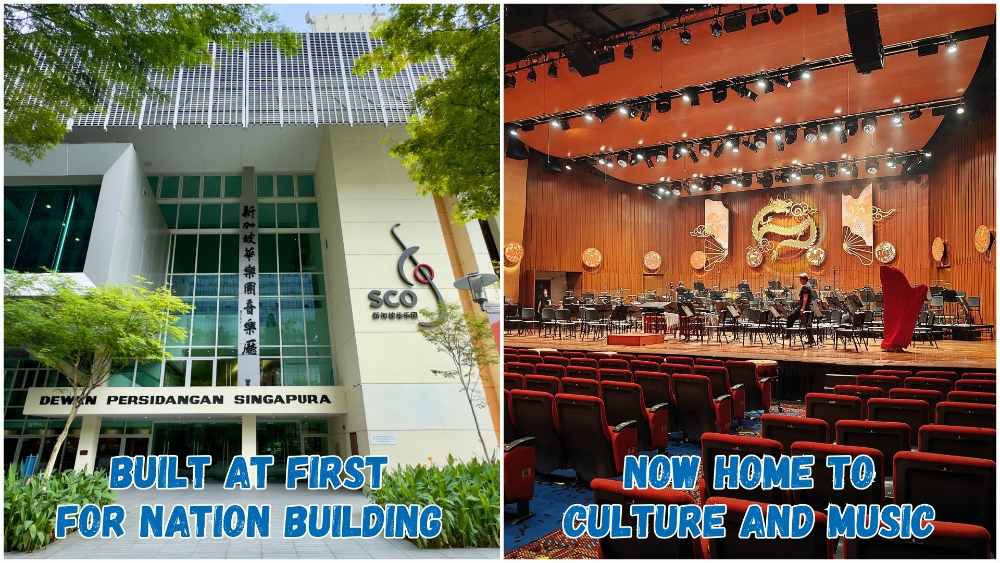
In this edition, we zoom in on the first post-colonial building to be gazetted as a National Monument, the Singapore Conference Hall.
📍 Location
The Singapore Conference Hall was the 62nd building to be gazetted as a National Monument. The MRT stations nearest to the Singapore Conference Hall are Tanjong Pagar and Shenton Way.
📅 Significant dates
Dates built:
- 8 Aug 1962-Sep 1965: Former Singapore Conference Hall and Trade Union House constructed
- Sep 1999-Sep 2001: Underwent renovations to reopen as the Singapore Conference Hall
Milestones:
- 15 Oct 1965: Former Singapore Conference Hall and Trade Union House
- Sep 2001: Singapore Conference Hall, "Home of the Singapore Chinese Orchestra"
Date gazetted: 28 Dec 2010
📜 History
Origins as the Former Singapore Conference Hall and Trade Union House
During the 1959 general election, the People’s Action Party (PAP) pledged to unify Singapore’s trade union movement as part of its five-year plan for the nation. Central to this vision was the construction of a dedicated headquarters for the unions.
In October 1960, the PAP government formed a planning committee led by then Minister for Labour and Law, K. M. Byrne, to assess the feasibility of building the proposed Trade Union House on a vacant site along Armenian Street, formerly occupied by St Andrew’s School.
By May 1961, the committee had selected an alternative site along Shenton Way. Spanning three acres, three times the size of the Armenian Street plot, the location offered greater potential. The new building was conceived not only as a hub for the Singapore Trades Union Congress (STUC) and its affiliated unions, but also as a venue capable of hosting international conferences.
An architectural competition was launched on 14 Jun 1961 to determine the building’s design. The winning proposal, submitted by William Lim, Chan Voon Fee and Lim Chong Keat of Malayan Architects Co-Partnership, was announced on 17 Mar 1962.
 IMAGE: SCH.ORG.SG
The foundation stone of the Trade Union House was laid on 8 Aug 1962 by M. S. Munusamy, a school janitor who was randomly selected from 42 rank-and-file workers and trade unionists. His role symbolised the everyday workforce to whom the building was dedicated.
Construction was completed in Sep 1965, and the Trade Union House was officially opened by then-Prime Minister Lee Kuan Yew on 15 Oct, just two months after Singapore gained independence.
The completed structure comprised two main sections: the Trade Union House and the Conference Hall. The former housed a canteen and offices for the NTUC Secretariat and union leaders, while the latter included exhibition spaces, a 1,000-seat auditorium, a press room, radio and broadcasting facilities, and additional office spaces.
 IMAGE: SCH.ORG.SG
Reopening as the Singapore Conference Hall
Between 1988 and 1989, the Singapore Conference Hall and Trade Union House underwent a $2.5-million renovation aimed at enhancing the National Trades Union Congress’s (NTUC’s) operational needs. Although the government had acknowledged by 1990 that a new and larger union headquarters was necessary, it took another decade before the NTUC eventually relocated to more spacious premises at the former POSB Centre on Bras Basah Road.
Following the move, the government leased the Shenton Way building to the Singapore Chinese Orchestra (SCO), which was in need of a permanent home for both rehearsals and performances.
The SCO subsequently carried out extensive alterations to adapt the space for its musical and organisational requirements. The renovation was completed in 2001, and the building was officially reopened as the Singapore Conference Hall on 22 Sep that year by then-Deputy Prime Minister Lee Hsien Loong.
Today, the former auditorium has been transformed into the SCO Concert Hall. The premises also include a resource library, score library, exhibition hall, sectional practice hall, and multiple studios, supporting the orchestra’s artistic and educational work.
⛳️ Milestones
Since its opening, the building has hosted numerous landmark events in Singapore’s history. It served as the venue for major national occasions, including the 1969 state banquet held to commemorate both National Day and the 150th anniversary of the founding of modern Singapore. Beyond domestic milestones, it also played a role on the international stage, hosting the first Commonwealth Heads of Government Meeting to be held outside London.
The Singapore Conference Hall was also the setting for National Day Rally speeches and the presentation of National Day Awards from the 1960s through to the 1990s. In 1993, it further cemented its place in the nation’s political history as the venue for the election of Singapore’s first directly elected President.
 IMAGE: NG KAI
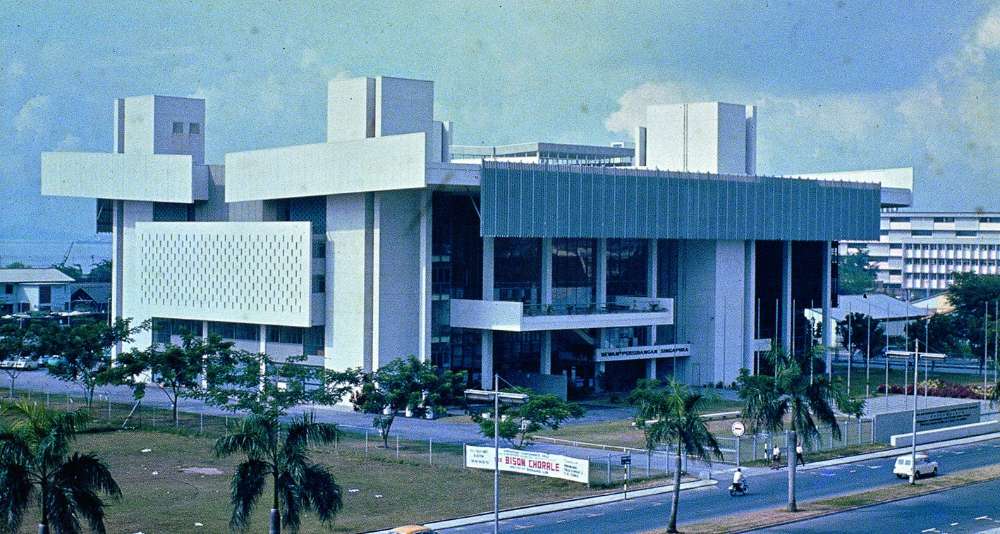 The building circa 1965. | IMAGE: FACEBOOK/@DOLBY THX
📐 Design and architecture
The building’s architecture is rooted in Modernist design, characterised by features such as a cantilevered (fixed or supported at only one end) roof and terraces that are integrated into the structure. At the same time, it reflects a strong sense of local identity through the use of vernacular materials, including locally sourced timber for the walls and ceilings.
The monument was also thoughtfully designed to suit Singapore’s tropical climate. Before land reclamation altered the coastline, its orientation and seafront location allowed the building to capture cooling sea breezes. Local hardwood was used to create sun-breakers that shielded the interior from harsh sunlight, while the distinctive butterfly roof, formed by two sloping roof planes meeting in a V-shape, channels rainwater efficiently towards a central downpipe.
Local Malayan motifs further enrich the building’s design. Mosaic tiles featuring traditional Malay mat patterns line the interior walls, a decorative style commonly found in local homes during the 1950s, anchoring the monument firmly in its cultural and historical context.
🕖 Opening hours
Regular visiting hours are daily from 8.30am to 6pm.
🎟️ Admission
Entry is free.
For the latest updates on Wonderwall.sg, be sure to follow us on TikTok, Telegram, Instagram, and Facebook. If you have a story idea for us, email us at [email protected].