

Slow Living In The Fast Lane: Meet The Singaporean Farming Snails In An Industrial Building
If you told a group of Singaporeans you were leaving your career to become a farmer, they might imagine you in a wide-brimmed hat under the sun in Lim Chu Kang. But for Stephanie Kudus (Steph), the founder of WholeSnail, the reality is much more "industrial chic".
Steph isn't your typical farmer. In her mid-30s, with a three-year-old in tow, she’s already lived several professional lives. Before she was the "Mother of Snails", Steph spent six years in investment banking at Merrill Lynch. A seasoned entrepreneur and self-proclaimed foodie, she later founded Pololi Group, Hong Kong’s first Hawaiian F&B chain. It was during her decade-long stint in the food industry that she became fascinated by alternative proteins, searching for foods that could be both sustainable and tasty.
When the time came to move back home to Singapore, Steph realized there was a real opportunity to pioneer something entirely new. Tucked away in a temperature-controlled industrial building at Pandan Loop off West Coast Highway, she has established Singapore's first-ever commercial snail farm, specialising heliciculture (impress your friends with this fancy term for “snail farming”) to produce high-end escargot and cosmeceutical-grade slime.
We sat down with Steph to talk about "jumping the gun" on her retirement dream, the resilience of snails, and why life in Singapore should be treated more like a marathon than a sprint.
Let's start at the beginning. What was the specific moment when you realised, "Okay, I'm really going to farm snails now"?
Actually, I've had many of these moments, to be honest. Ever since I was very young, when I was in school, I've always been fascinated by snails or escargot. I went to school in California, and because of that, having escargot with a bottle of wine was my dream. So, I've always thought that being a snail farmer when I was older would always be my dream come true.
When I moved back to Singapore, I was super pregnant with my son, and after I gave birth, I was looking for something to do. I came across insect farming, and I think that was my aha moment. Like, why not take it one step further and farm snails at the end of that cycle?
When I started looking more and more into it, it really convinced me to say, “Steph, you are on to something and this can be done because it's not good enough to just want to upcycle food waste. It's important that you actually make money doing it.” And snails have proven that they have the potential to be The One.
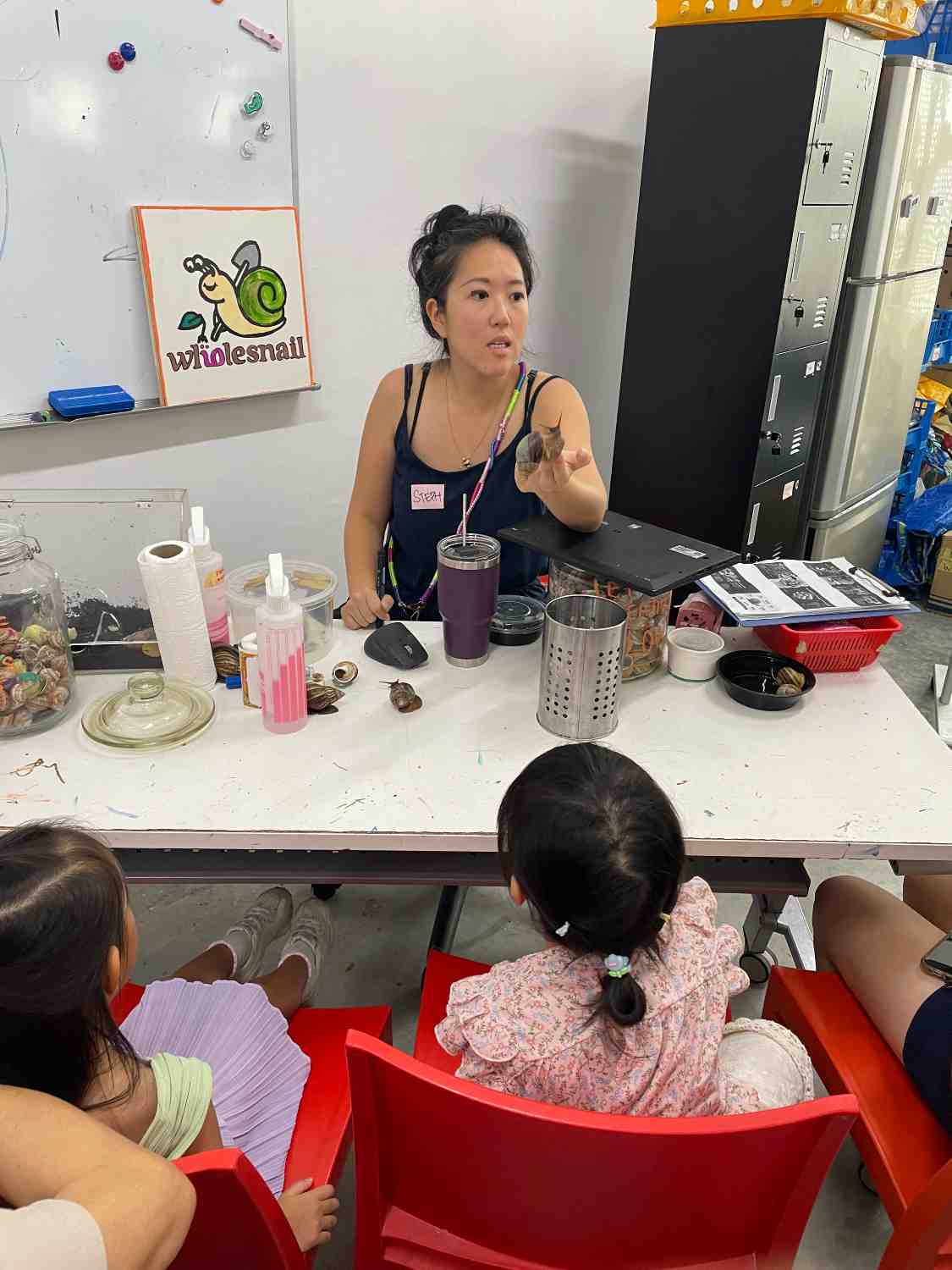 Steph doing a show-and-tell during one of WholeSnail's farm tours. | IMAGE: SIM DING EN
What did your friends and family say when you first told them about this concept?
I think they were in shock – because I was 30 years old and wanting to jumpstart my retirement dream. And obviously they thought, what is going on?
But knowing me, I would always be the one to try something new or take a leap of faith. And I think this was not out of the ordinary for a lot of my friends, especially the ones that went to school with me. They knew that I've always been obsessed with snails. So I guess to a lot of them, it was not a huge surprise. But for me, you know, becoming a farmer has always been just so left field. I didn't think that I would be farming snails for commercialisation. I thought I would just be farming them for myself.
It's definitely a unique career path! What would you say are your most snail-like traits?
Okay, so for those who know me, I'm super quick, like, super fast. I move at 100 miles an hour. Very un-snail-like. But when I started observing and hanging out with snails, I realised that there is beauty in the snail.
I would say they are extremely resilient. So that would probably be my number one snail-like trait. They’ve adapted, they've been around for such a long time, and they’re still useful even though they have terrible eyesight.
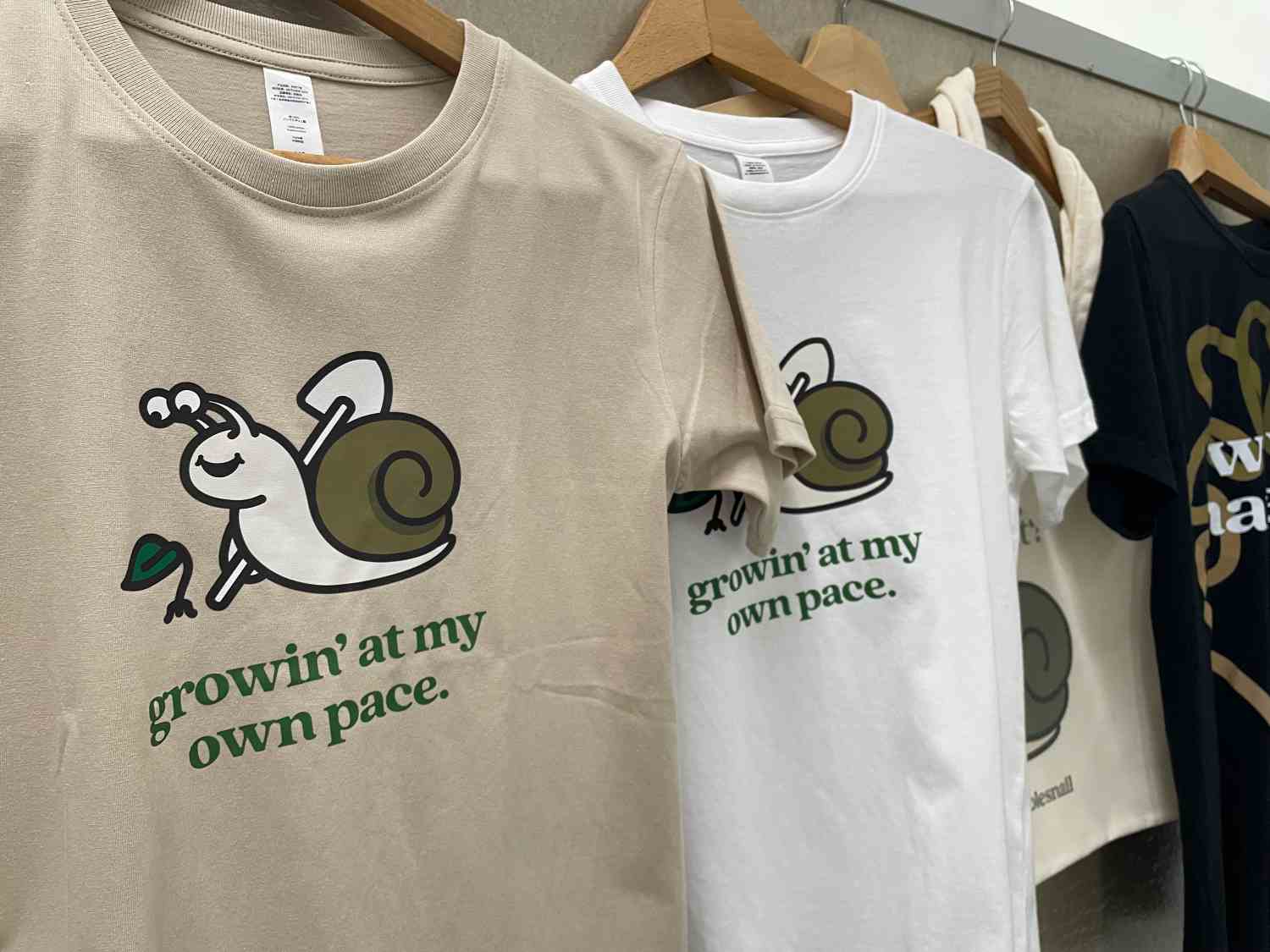 Wearable merch with life lessons. | IMAGE: SIM DING EN
Snail farming sounds like it requires a lot of patience. What's the biggest life lesson it has taught you?
Growing at my own pace. I grew up in Singapore and I always felt like I was in a rush to go somewhere. I graduated from UCLA at the age of 20. And to be honest, looking back, I don't even know why I was in such a rush. I wish someone had just told me to slow down, enjoy the moment. And really, life is a marathon, not a sprint.
Singaporeans usually react quite strongly to snails. Why do you think that is?
I think for a lot of the Singaporeans I've met, their core memory when it comes to snails is the sound that a snail makes when they step on it. And I think that sound is so definitive. It's so special that it really sticks with them.
It's not that we are not used to eating it. Actually, we've been eating snails since the beginning of time. And in Singapore, you know, there're so many different types of snails, water snails like gong gong, which you can eat at Chomp Chomp, for example. But I think for many, eating a snail is like, it's so cute, should you be eating it? Apart from that, we understand very, very little about these creatures.
What's been the funniest response you've received when you tell people what you do?
I think it's normally shock! I'm usually the only snail farmer that they've ever met in their life. And so many questions start to come out like, “Why snails?”, “What type of snails?”, “What about the snails in my garden?”
A lot of people try to offer me the snails in their garden, and I have to tell them, that's not really the snail that I farm. But also, I think when they think of what a snail farmer is or does, they think that I'm out in some really, really ulu area growing my snails, but they don't realise that we are actually an industrial building and growing snails indoors.
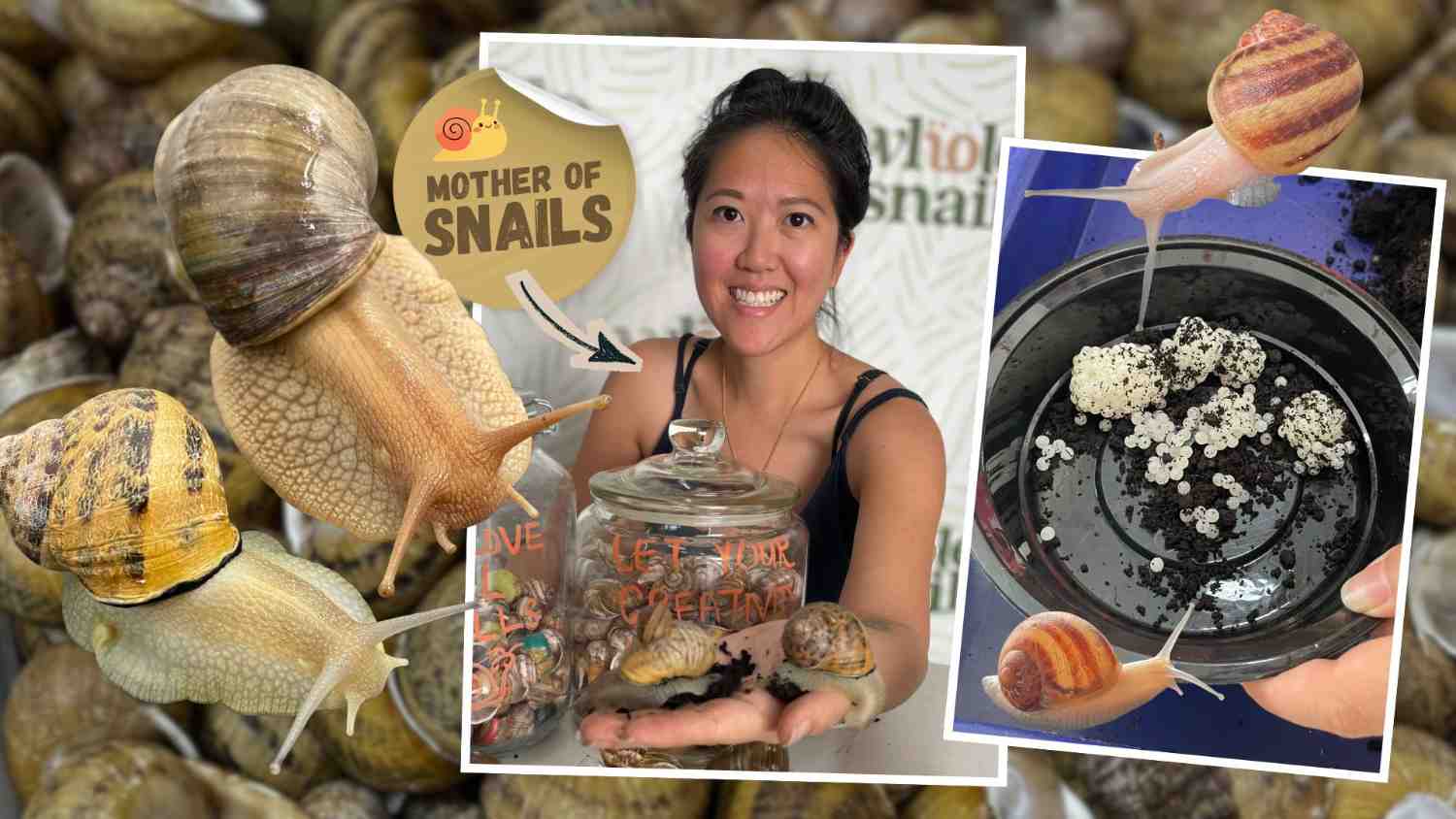
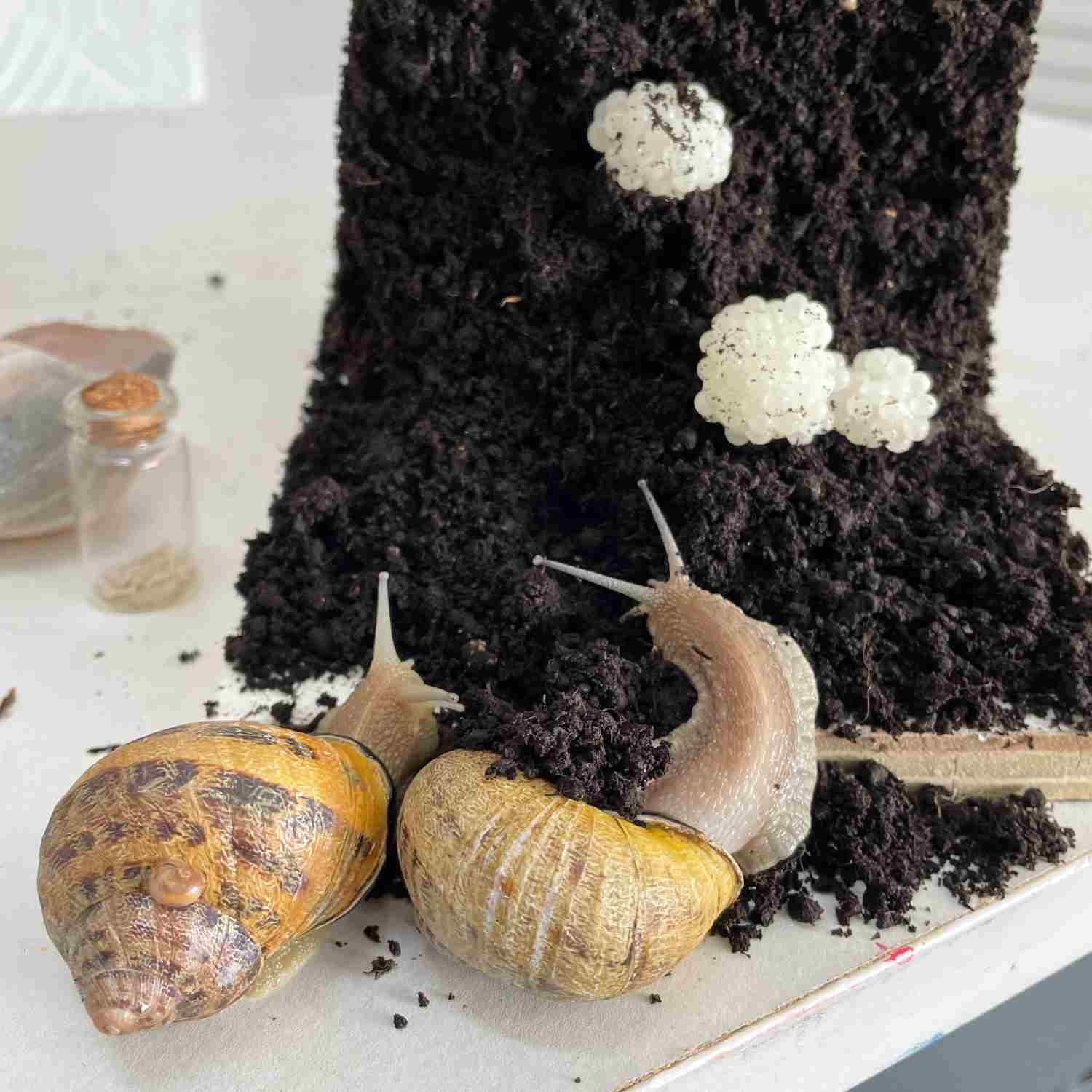 A healthy batch of snail eggs. | IMAGE: SIM DING EN
You’re a mom to a three-year-old. How does motherhood change your perspective on taking a risk like this?
Because he's really young, I feel like it is also my chance to try something else. I see him struggling with even learning how to tie his shoelaces, right? If I can teach him how to tie his shoelaces, then I can teach myself how to farm snails.
But I think he's also taught me a lot, like, needing to slow down. And I find myself slowing down, especially with him. And when I come here, the snails are just a direct reflection of him growing. It's a part of who we are now.
Does your son understand that his mom is essentially a "snail queen"?
So he actually really loves snails. Whenever it rains, I'm always there with a plastic bag trying to look for snails. And I think it's obviously rubbed off a lot on him. He tells everyone at school that his mom is a snail farmer, which is great.
When he sees a snail, he'll always be like, "Do you want to take that to your farm?" He's come [to the farm] with his cousins and he's very excited to show them like, "This is a snail, this is what we're doing." So even though he's three, he's very aware that his mom is a snail farmer.
You're an entrepreneur, a mom, and a farmer. How do you carve out "me time"?
I love being around people. I do recharge my batteries by being around extremely inspiring people as well. So, hanging out with friends, having a bottle of wine with people, talking about life, about snails, or just anything in general, that is my me time. Or taking long walks – that's also been fantastic for me, especially in Singapore, because you can walk everywhere.
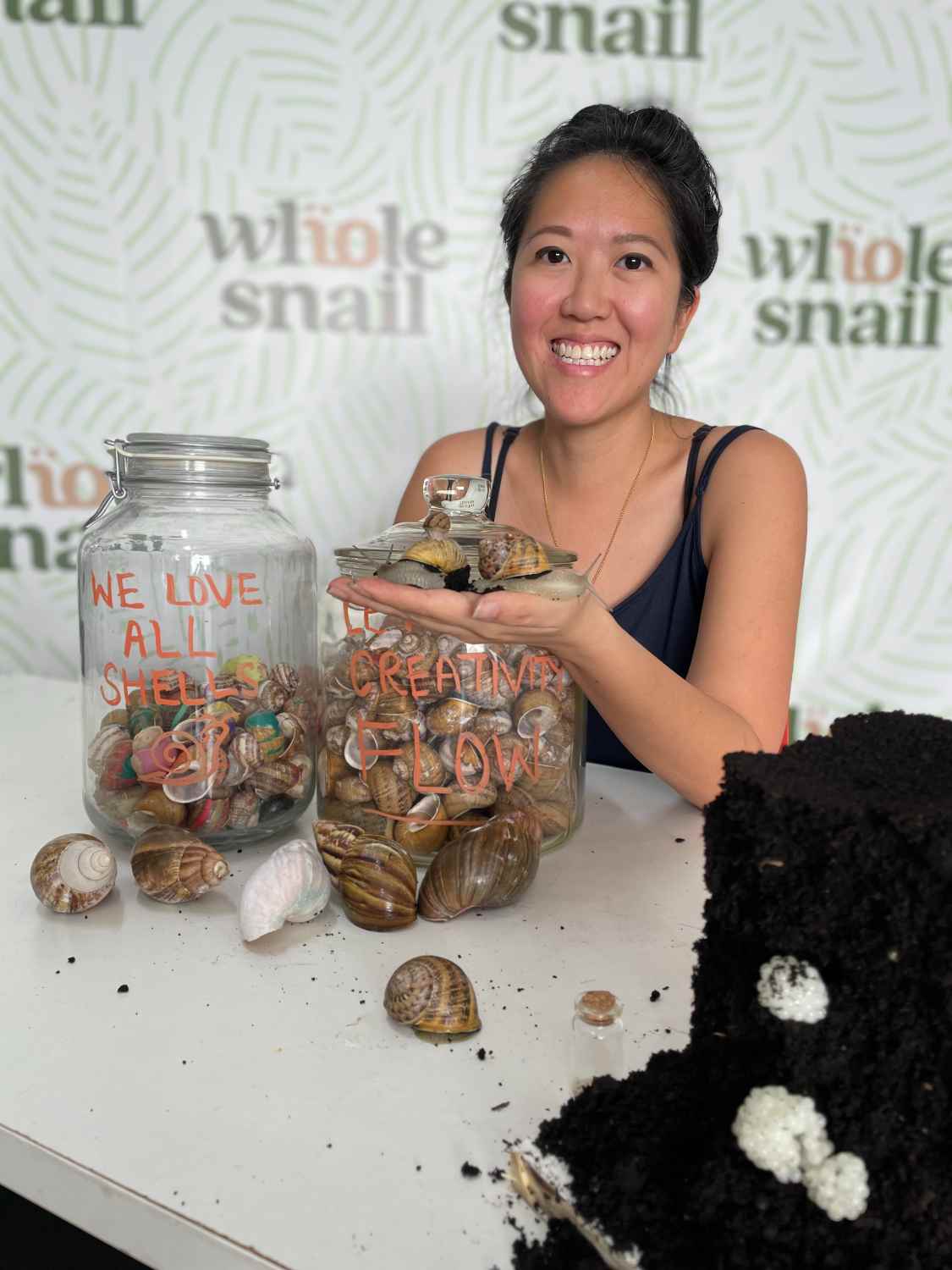 Dealing with the snails is the easiest part of her job as an entrepreneur, says Steph. | IMAGE: SIM DING EN
Has it become a job hazard to be always on the lookout for snails?
Okay, so I'm extremely scared of snakes. And unfortunately, the best time to go and find a snail is around the same time you find snakes – after rain or when it's cold. So I would say the only job hazard I have is if I see a snail and I really want to save it or move it out of harm's way, something scary might jump out at me.
But no. In general, they're so gentle and they're so slow. I can always go and find a pair of chopsticks and come back and they'll still be around the same area.
What does a tough day at the farm look like, and what keeps you going?
Dealing with the snails – actually, that's the easiest part of my day. How to run a business, what are our costs, what is it that we are missing... I think my expectations are really high, not just of myself, but also of the team. And I think sometimes it's really difficult to translate these expectations into actionable items.
What keeps me going? I think when I speak to people about snails and I see their faces change, it really reinforces what we're doing here and why we're doing it? 99% of the people who come here for tours will always leave with a new perspective when it comes to snails. And who knows what that might spark? It reminds me why we're here doing what we're doing, even though it's so difficult.
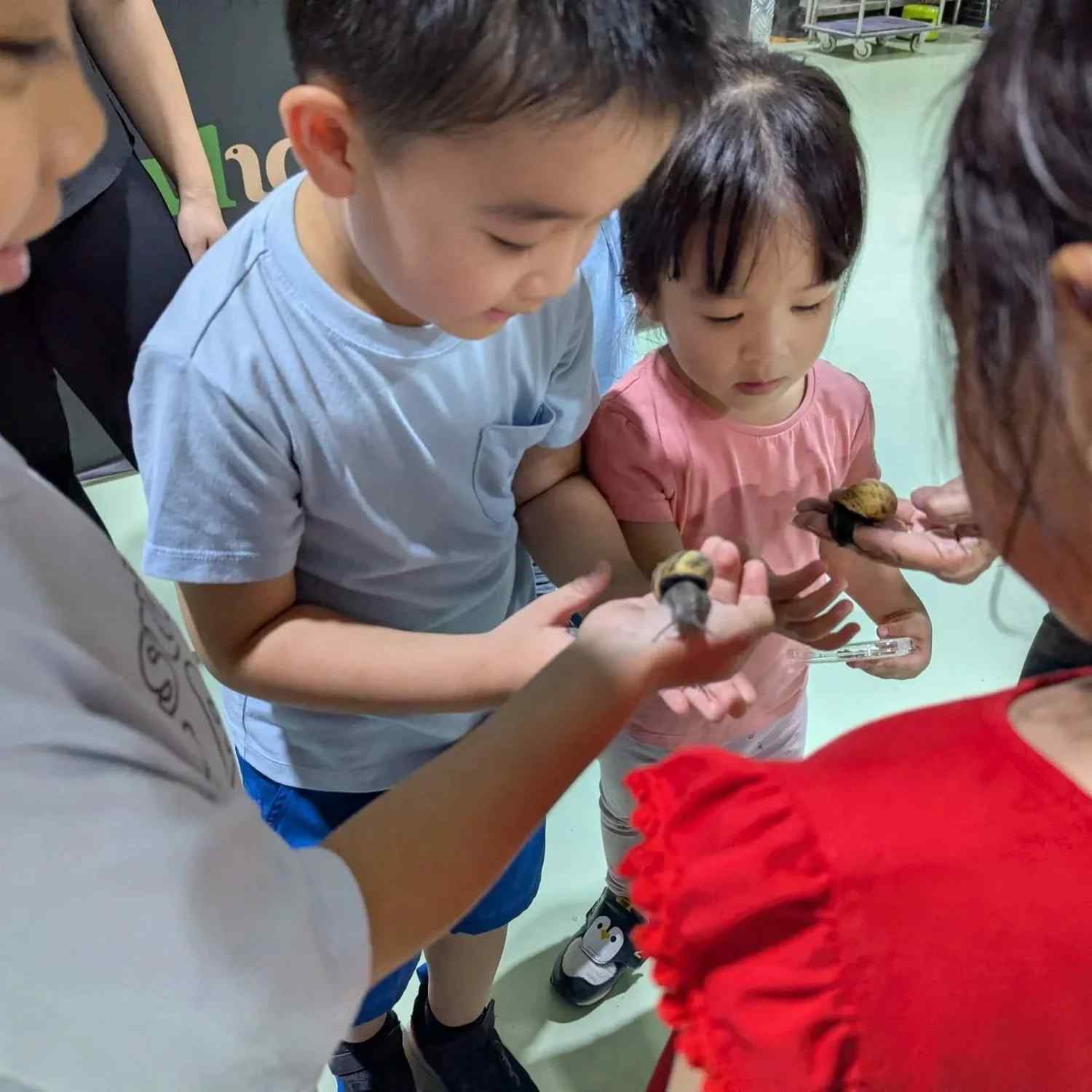 Farm tours at WholeSnail are by appointment only, $25 per pax, open to ages 3 and above. | IMAGE: WHOLESNAIL.COM
You do tours for all ages. Would you rather explain snail farming to kids or aunties and uncles?
I would probably choose the aunties and uncles just because these aunties and uncles might already have in their mind a preconceived notion of what snail farming looks like or what snails are. And I think when I break that barrier down, the eventual shock is like, oh my goodness, they never ever thought about it their entire life.
It's really nice to see that if I can convert someone who is 70 plus years old into a snail lover, then I can do anything!
For the latest updates on Wonderwall.sg, be sure to follow us on TikTok, Telegram, Instagram, and Facebook. If you have a story idea for us, email us at [email protected].