



This National Monument In Little India Has A Chinese-Translated Quran — And A Forgotten Basement
Masjid Abdul Gafoor in Singapore is a National Monument tucked among the shophouses of Little India – and behind its grand facade are details I genuinely didn’t expect to find, like a Quran translated into Chinese.
I spotted it in the small gallery beside the prayer hall while visiting the mosque recently, alongside displays explaining Islam and the building’s history. It was such a simple detail, but it stuck with me. In a mosque historically tied to Singapore’s Tamil Muslim community, here was another reminder of how faith can cross cultures and languages.
And that was only one of my several discoveries inside the compound.
There’s also a basement that was basically forgotten for decades, a huge sunburst bearing the names of 25 Islamic prophets (from Adam to Muhammad), and an architectural mash-up that somehow combines onion-shaped domes with Roman-style columns.
Safe to say, Masjid Abdul Gafoor has aura.
Overview
Official name: Masjid Abdul Gafoor / Abdul Gafoor Mosque
- Address: 41 Dunlop Street, Singapore 209369
- Present mosque built: Construction began in 1907 and was completed around 1910
- Original community served: Tamil Muslim traders and Baweanese syces (horse groomers) and horse trainers
- Current use: Active mosque
- Year gazetted as a National Monument: 1979
- Nearest MRT: Jalan Besar or Rochor
- Admission: Free
- Visitor hours: Monday to Thursday and Saturday to Sunday, 10am–12pm and 2pm–4pm; closed to visitors on Fridays
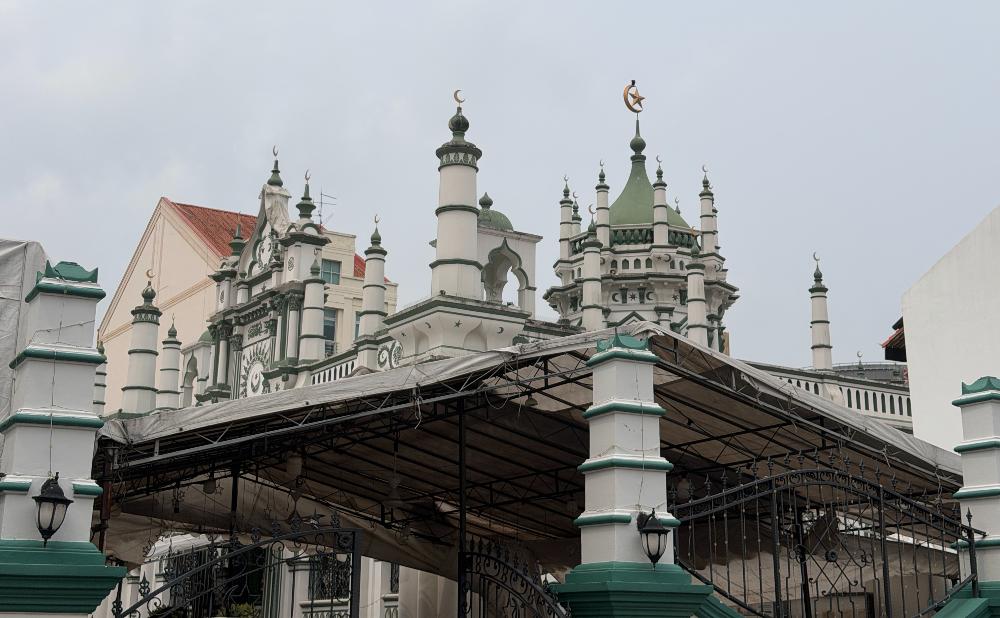 IMAGE: NG KAI
Why Masjid Abdul Gafoor is worth stepping inside
I’ve seen photos of the mosque before, but in person, it's giving grand.
It sits along the relatively narrow Dunlop Street, surrounded by Little India’s colourful shophouses, where out of nowhere you see this incredibly ornate building covered in arches, columns, stars, crescents and miniature domes.
Its design blends Saracenic and Neoclassical architecture: Islamic-influenced cinquefoil (an ornamental design of five lobes arranged in a circle) arches and onion-shaped domes sit alongside Corinthian and Doric pilasters (rectangular columns) inspired by classical European architecture.
What made my visit especially enjoyable was that I didn’t feel like I had to figure everything out myself. The staff were super welcoming and helpful, and there’s a small heritage gallery located beside the mosque where visitors can learn more about Islam and the mosque before or after exploring the main prayer hall.
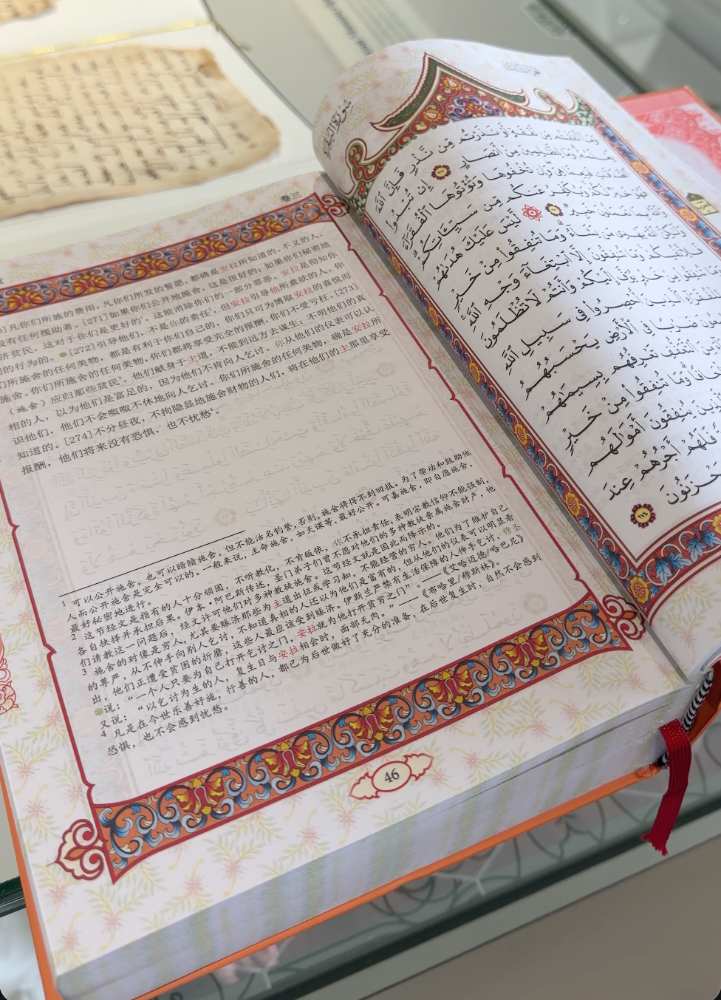
IMAGE: NG KAI
That was where I spotted the Chinese-translated Quran; definitely not something I expected going in.
Before Masjid Abdul Gafoor, there was a much simpler mosque
The roots of Abdul Gafoor Mosque can be traced back to the mid-1800s, with the construction of Al-Abrar Mosque (which was also known as Dunlop Street Mosque; this should not be confused with Al-Abrar Mosque at Telok Ayer street) in 1859. The Dunlop Street Mosque was a simple wooden structure with a tiled roof, and made of brick and chunam (a cement or plaster used in India).
It catered to the religious needs of Tamil Muslim immigrants from South India trading in Kampong Kapor, and Baweanese syces (horse groomers) and horse trainers working at the former Farrer Park racecourse.
That little historical tidbit immediately made its backstory feel more tangible to me. Today, Little India is packed with shops, restaurants and tourists; back then, some of the people worshipping here were literally looking after horses at a nearby racecourse.
The mosque was partly funded by… shophouse rent
In 1881, the Dunlop Street Mosque Wakaf (Endowment) was established, and Shaik Abdul Gafoor bin Shaik Hyder (a Tamil Muslim), the chief clerk in law firm Khory & Brydges, was one of two appointed trustees.
As a trustee of the mosque, Abdul Gafoor obtained permission to build shophouses surrounding the mosque. In 1887, eight shophouses and nine sheds were erected, followed by another set of shophouses in 1903. Today, some of these structures on Dunlop Street and Mayo Street still exist and belong to the mosque.
With the income generated from the surrounding properties, construction on a new brick mosque commenced in 1907. By 1910, the old mosque (Dunlop Street Mosque) was no longer in use for religious activities. Upon Abdul Gafoor's passing in 1919, the mosque was renamed Abdul Gafoor Mosque in his honour.
What to look out for when you visit
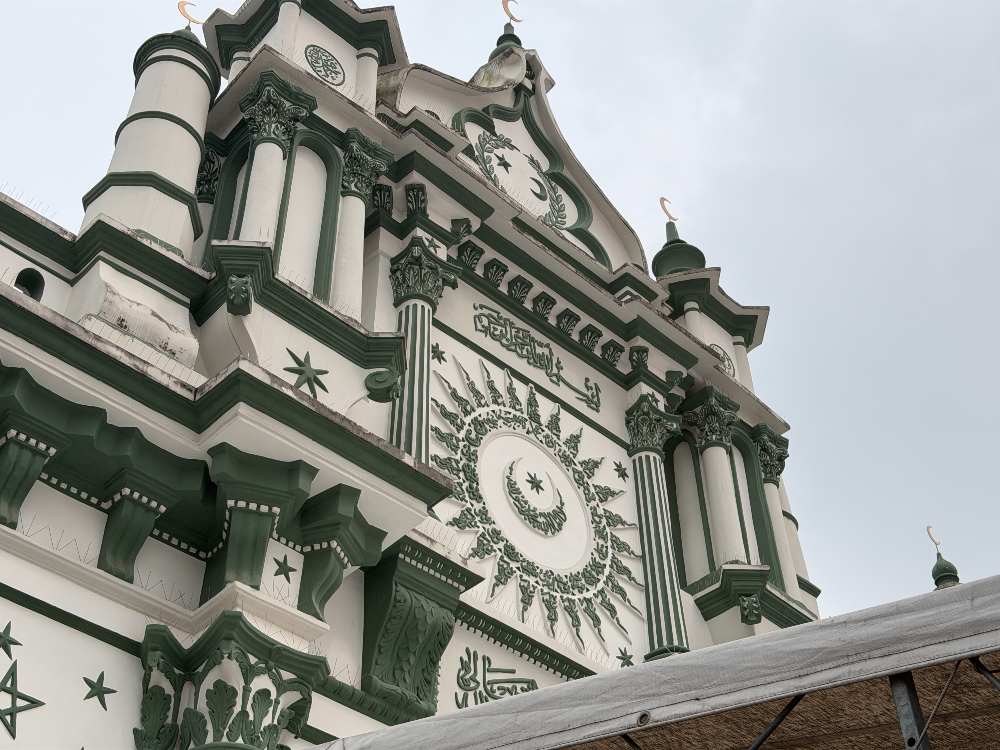 IMAGE: NG KAI
That massive sunburst above the entrance
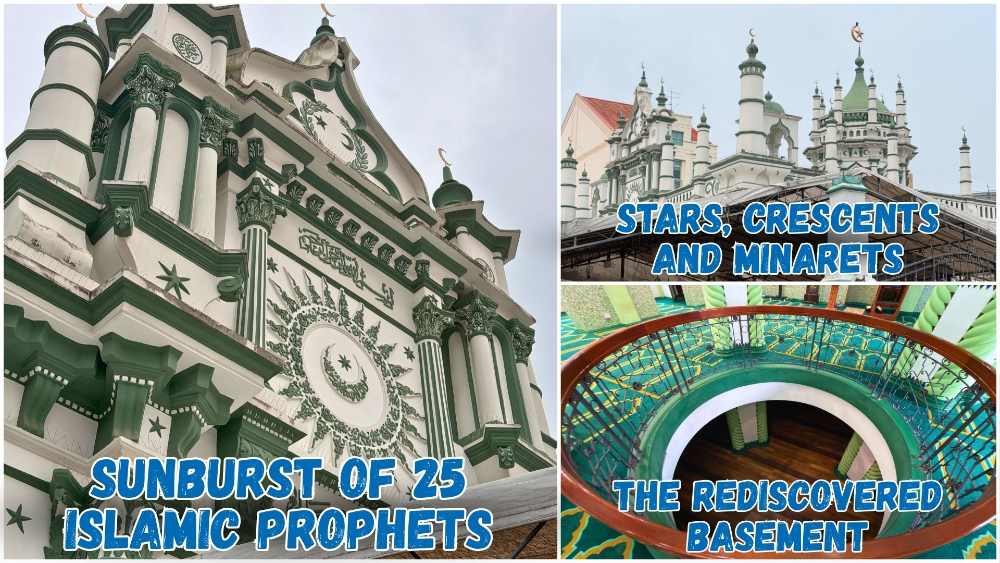
Above the main entrance is an elaborately decorated sunburst (a design consisting of rays or "beams" radiating out from a central disk in the manner of sunbeams). It's bounded by two fluted (ridged) pilasters and crowned with an onion-shaped pediment (upper part of the front of a building). The sunburst is also embellished with Arabic calligraphy depicting the names of 25 Islamic prophets, from Adam to Muhammad.
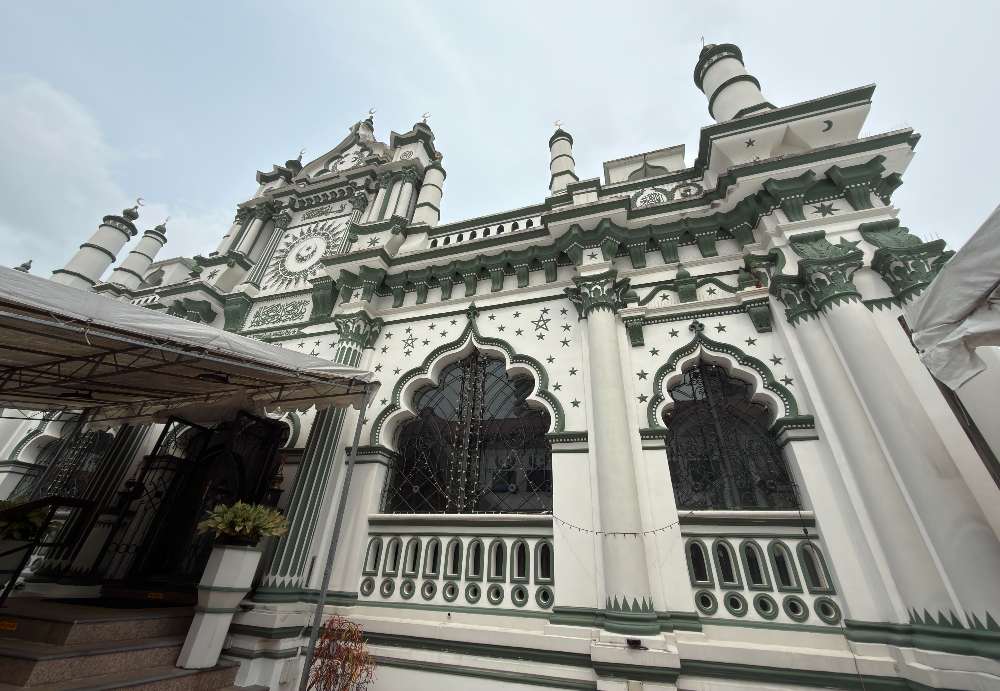 IMAGE: NG KAI
The architecture is a whole mash-up
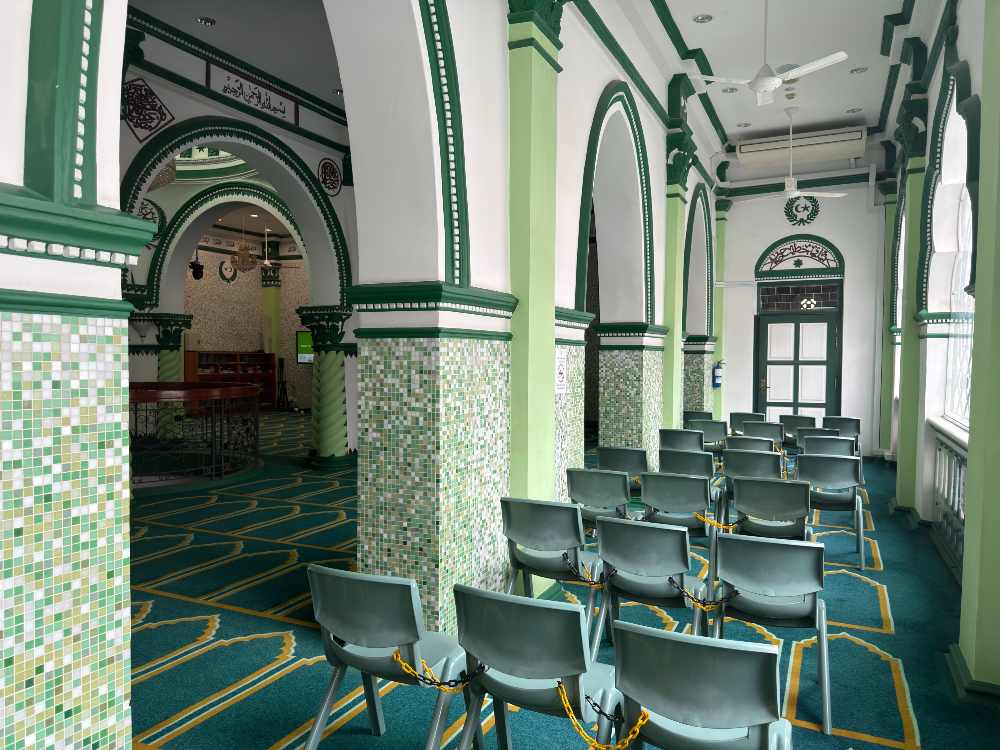
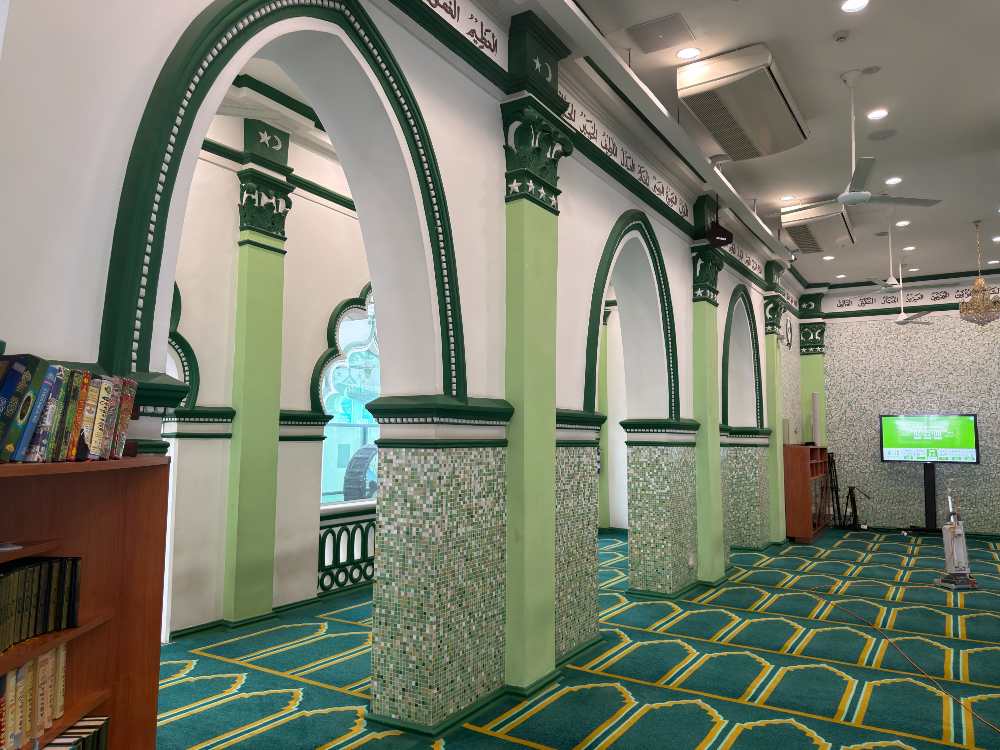
The design of Abdul Gafoor Mosque is a stunning blend of Saracenic and Neoclassical elements. The main prayer hall's verandas showcase stunning cinquefoil (an ornamental design of five lobes arranged in a circle) arches with intricate mouldings, reflecting Saracenic design influences. They are contrasted against the many Neoclassical Corinthian and Doric pilasters (rectangular columns).
Crescent moon and star motifs - symbols usually associated with the Islamic faith - adorn the exterior walls, while minaret-like structures along the roof parapet are each topped with a mini ogee-shaped (onion-shaped) dome and crescent moon.
Talk about design-maxxing...
 IMAGES: NG KAI
The main prayer hall
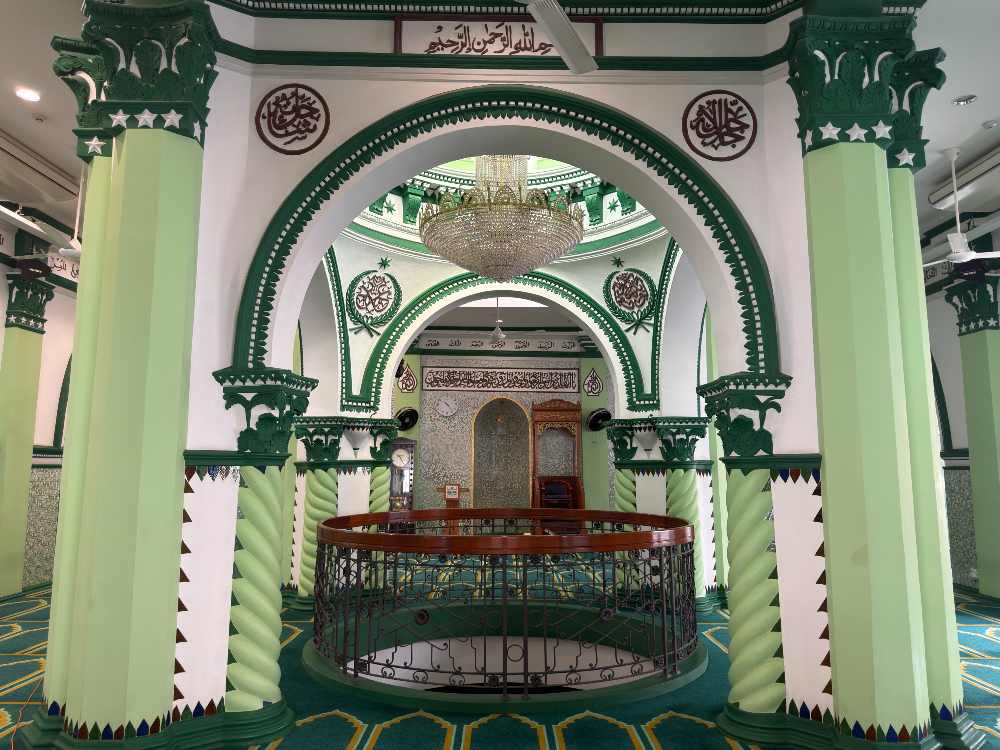
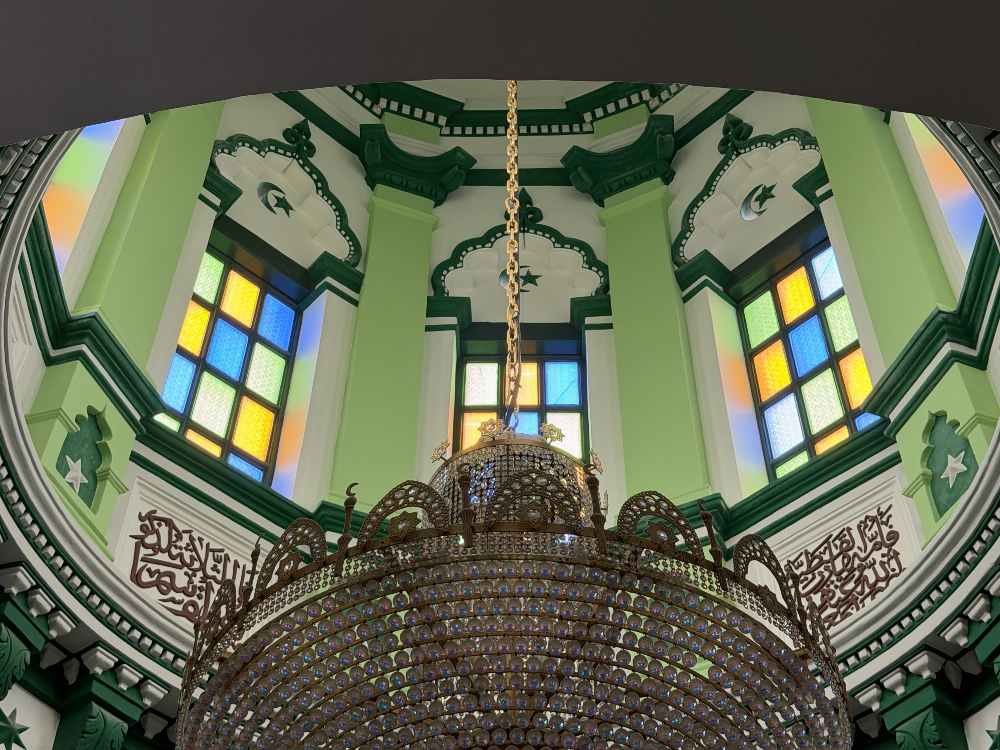
In the heart of the prayer hall stands a majestic cupola, a hexagonal-shaped tower rising from the roof deck. The cupola comprises three tiers: coloured glass panes decorate its base, then capitals (the tops of columns) and balustrades (railings comprising vertical posts) with bottleneck-shaped carvings in the middle tier. At the peak is an onion-shaped dome topped with a star and crescent moon at its apex, flanked by minarets at the corners.
Positioned directly above the prayer hall, the cupola is accessible via a staircase at the rear of the building, leading to a flat rooftop deck. The rooftop is encircled by a parapet adorned with at least 22 miniature minarets echoing the design of the onion domes, crescent moons and stars.
 IMAGES: NG KAI
Inside the prayer hall, a panel inscribed with a verse from the Quran hangs above the mihrab, a niche in the wall of a mosque that indicates the qibla (the direction of the Kaaba in Mecca towards which Muslims should face when praying).
The little heritage gallery beside the mosque
My recommendation: don’t leave after admiring the architecture.
The heritage gallery gives useful context about Islam and the mosque, which is interesting if – like me – you’re visiting mainly because you’re curious about the building and want to understand what you’re seeing.
And yes, this is where I found that Chinese-translated Quran. In such a historically multicultural neighbourhood, it felt oddly fitting.
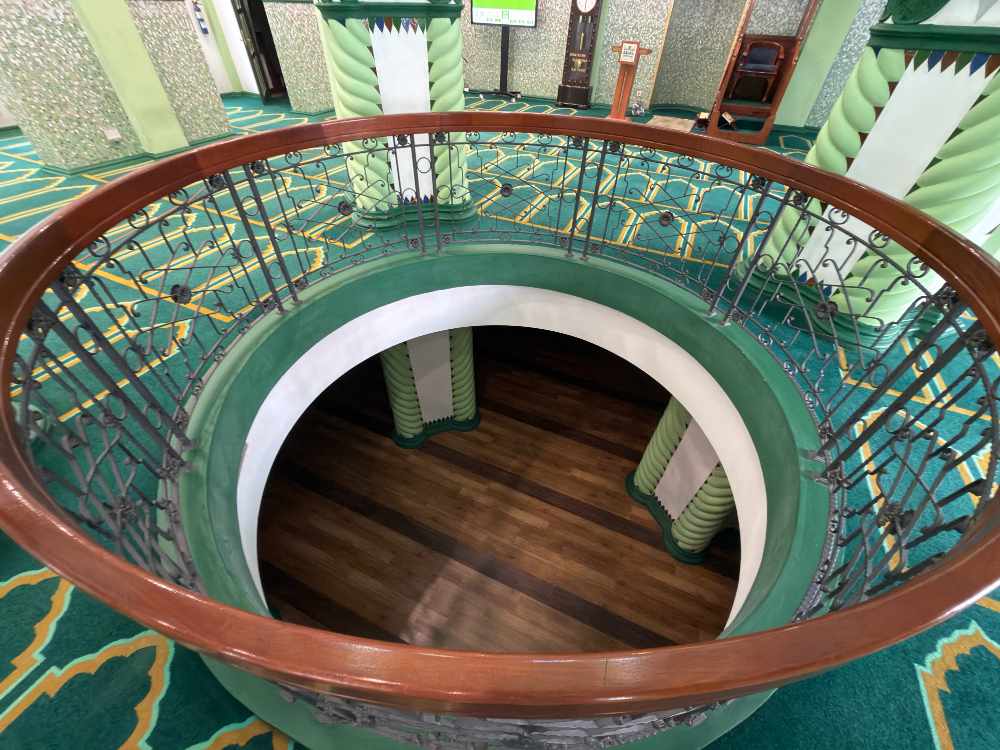 IMAGE: NG KAI
The mosque has an entire forgotten basement
This might be my favourite random fact about the building.
In 1998, a forgotten basement beneath Abdul Gafoor Mosque was rediscovered. Mistaken for storage space, the mosque's committee had originally planned to expand the prayer hall to accommodate more worshippers.
However, after the mosque's original building plans were found in the National Archives of Singapore, a roomy basement that was suitable for holding hundreds of worshippers was revealed. The spacious basement was then refurbished with air-conditioning to fit 600 worshippers; it increased the main prayer hall's total capacity to 1,200.
Today, after several more rounds of renovation works, the mosque can fit at least 4,000 worshippers at once.
Masjid Abdul Gafoor today
Masjid Abdul Gafoor remains an active place of worship and continues to serve Singapore’s Muslim community, with particularly strong historical links to the Tamil Muslim community. The mosque even provides religious classes in Tamil.
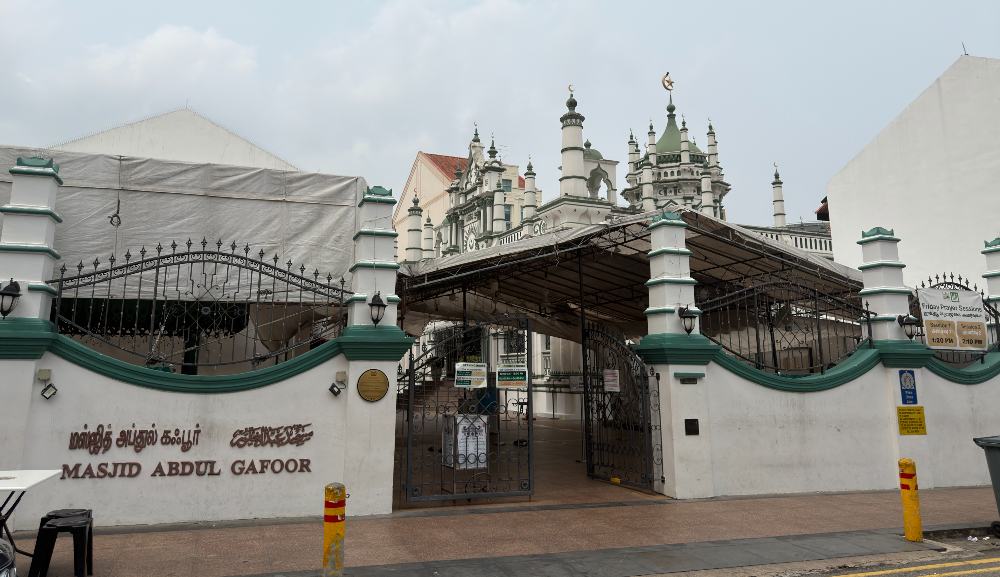 IMAGE: NG KAI
Thinking of visiting Masjid Abdul Gafoor?
Seeing pictures of it online was cool. But actually visiting it? That made a big difference to my experience.
Stepping inside, seeing the prayer hall, chatting with the staff and browsing the gallery gave me a much better understanding of why the place matters beyond simply being a very photogenic National Monument.
During my visit, photos and videos were allowed, and cover-ups were available if needed.
Just remember that this is first and foremost an active place of worship: dress respectfully, keep your voice down, and leave your footwear near the entrance before entering the prayer spaces.
Wait, what makes something a National Monument?
In Singapore, National Monuments are buildings, structures or sites recognised for their national significance and value to our built heritage. They are gazetted by the Preservation of Sites and Monuments, a division of the National Heritage Board, which is why the title is reserved for places that carry especially important historical, architectural, social or cultural meaning.
As of 2026, Singapore has 77 National Monuments. Some are obvious landmarks, like the Padang, St Andrew’s Cathedral and Fort Siloso. Others are places you may have walked past without a second thought, which is exactly why this series exists.
One National Monument at a time, we’re here to uncover the stories hiding in plain sight.
For the latest updates on Wonderwall.sg, be sure to follow us on TikTok, Telegram, Instagram, and Facebook. If you have a story idea for us, email us at [email protected].