
Why Is Beyblade Popular Again In Singapore? The Comeback Is More Than Millennial Nostalgia
"LETTTT ITTTTT RIP!" If you grew up in Singapore in the early 2000s, there's a fair chance you would've heard this famous Beyblade catchphrase echo through your TV screens on any given Saturday morning. I certainly did.
As a 10-year-old, the likes of Pokémon, Power Rangers and Digimon were part of my childhood staples. Kids Central was always on by default. But there was nothing quite like Beyblade.
Watching those little spinning tops crash into each other in a battle arena, or Beystadium, completely hooked me. Beyond the anime series, the experience of playing Beyblade was such a rush. It was loud, competitive and, most importantly, something you could actually do with your friends during recess and after school.
My Beyblade childhood in 2000s Singapore
I vividly recall proudly owning a Dragoon Storm, the signature Beyblade of the main protagonist of the TV series, Tyson Granger, along with a Beystadium that occupied far too much space in my room.
Back then, my primary schoolmates and I didn't think of ourselves as part of a hobby community. We just played. Beyblade was another thing to do alongside our Game Boy consoles, PlayStation 2, Pokémon cards and whatever else we were obsessed with in that era.
But like all things, I eventually outgrew my Beyblade phase as I entered my teen years and beyond. I honestly thought the sound of ripcord launchers and clashing tops would be confined to the nostalgia of the 00s.
But fast forward to present day more than 20 years later, somewhat bizarrely, it's making a comeback. Except this time, I am the millennial watching from the sidelines. So, when did Beyblade become popular again in Singapore?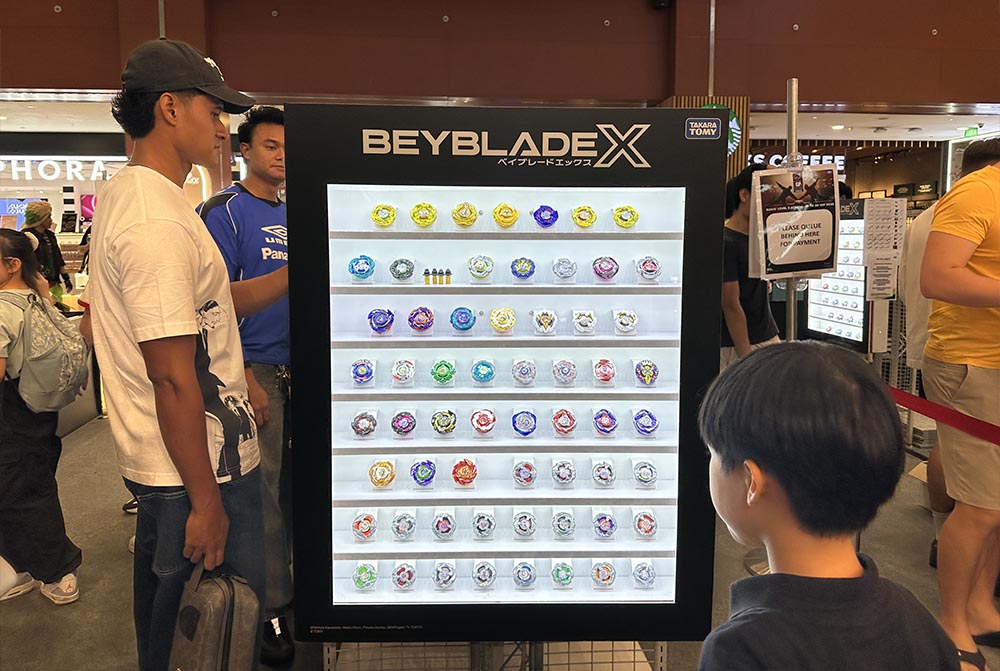
Beyblade has come a long way since its initial wave of popularity | IMAGE: FARHAN SHAFIE
What exactly is Beyblade?
For those who somehow missed the craze, Beyblade is a Japanese battling spinning-top toy franchise that debuted in 1999. While the name and concept were inspired by the traditional Japanese spinning top game beigoma, the idea of battling spinning tops isn't unique. It has parallels with other traditional games across Asia. Even in Southeast Asia, we have our own long-standing spinning-top version, the traditional Malay gasing.
The basic game is straightforward: launch your Beyblade into a plastic reverse dome stadium and try to knock your opponent out, stop it from spinning or, depending on the generation, trigger other ways of scoring. Players can also customise their Beyblades using different components to suit different strategies.
But the modern Beyblade took that simple idea and turned it into a full-blown multimedia franchise, complete with manga, anime, and collectible parts. In its heyday, it was easily the best-selling analogue toy at the turn of the millennium.
The original generation ran from 1999 to 2004, but as I would soon find out, a 4th generation series, called Beyblade X, was launched in 2023. It sparked the toy's recent revival, introducing it to a whole new generation of kids.Inside the Beyblade community
My first proper reminder of Beyblade's comeback was when a friend randomly invited me to a Beyblade gathering at The Playground, a hobby store in Bukit Merah.
I wasn't expecting to walk into what looked like a proper, thriving community of Beybladers, young and old. There were even a couple of father and son combos teaming together. Bless all these millennial dads passing this hobby on to their next of kin.
There was clearly a level of knowledge and enthusiasm that went way beyond the casual battles I remembered from primary school. That's how I found out about a competitive Beyblade community, where the highest tiered tournament is called the G1, which hosts Beyblade X events across the region culminating in a world championship tournament each year. There's some serious top spinning going on here.
What's it like to watch a Beyblade X tournament in Singapore?
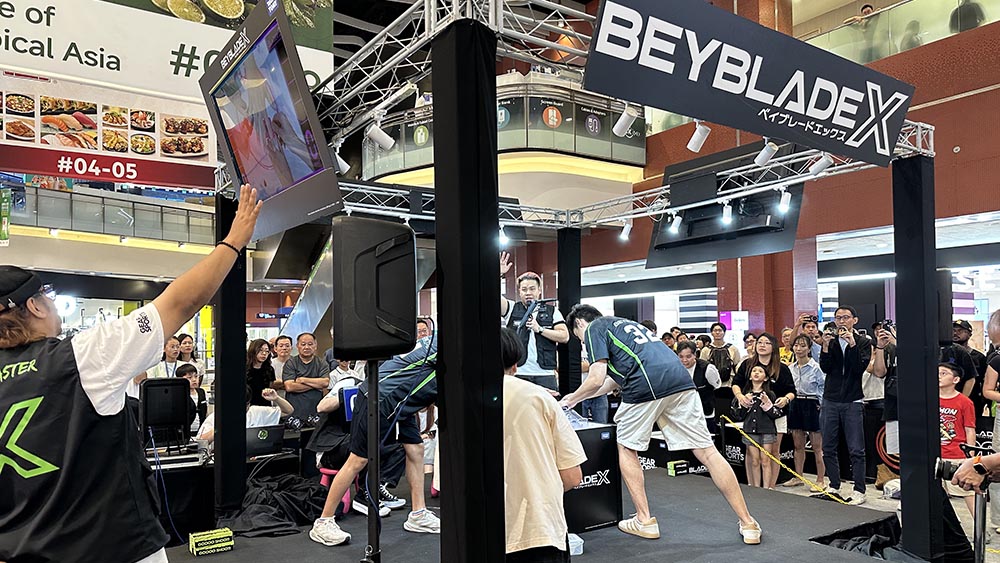
I recently attended my first G1 Beyblade tournament finals at Bugis+, and honestly, I wasn't prepared for how much attention the event attracted.
The qualifiers had taken place over the course of the week before culminating in the finals, with players and spectators gathering around the battle areas to watch the action. It was quite the diverse crowd; families with young kids, teens with their friends, and even a few senior citizens were spotted competing.
What struck me the most about the afternoon was that the winners of the "Open" and "Regular" categories represented two completely different generations.
One was clearly a millennial who could very plausibly have grown up watching the exact same cartoons and playing the exact same Beyblade toys that I did. Meanwhile, the other victor looked like he was still in primary school.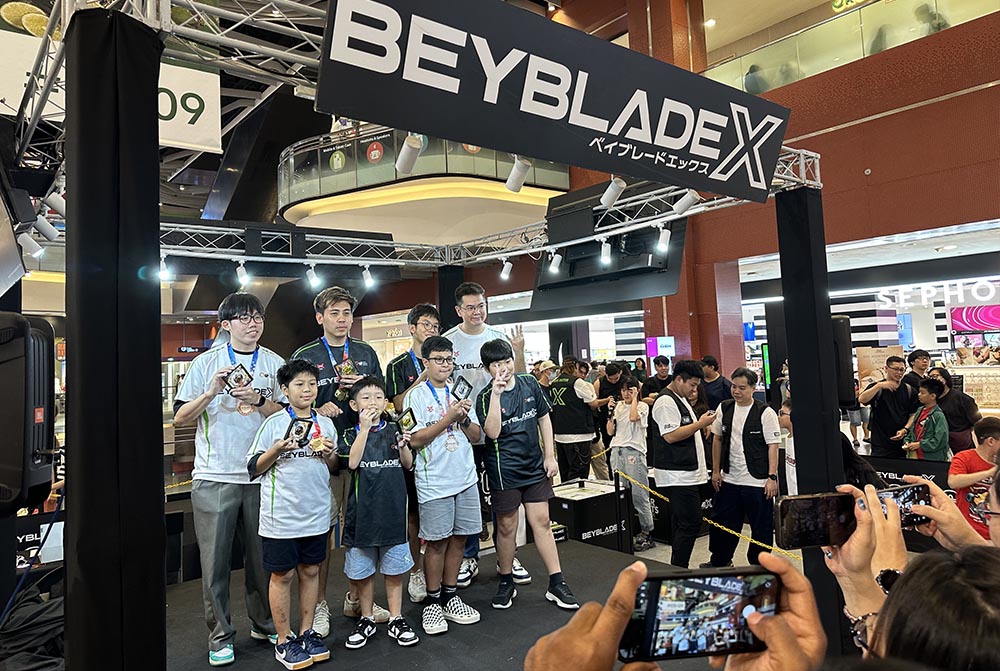 Open category and Regular category winners and finalists pose with their medals. In December, champions from each category will head to Bangkok for a final showdown| IMAGE: FARHAN SHAFIE
The stakes were considerably high as well. Singapore's qualifying tournament forms part of the international Beyblade X competition pathway, with winners progressing towards regional and ultimately global competition. The 2026 GP Final will take place in Bangkok in December.
Watching it live, I realised this wasn't the same Beyblade I remembered. And that's not a bad thing. It's clearly blossomed into a fully-fledged community, and hey, if you can compete and earn money from battling with spinning tops, more power to you!
Maybe analogue toys still have a place after all
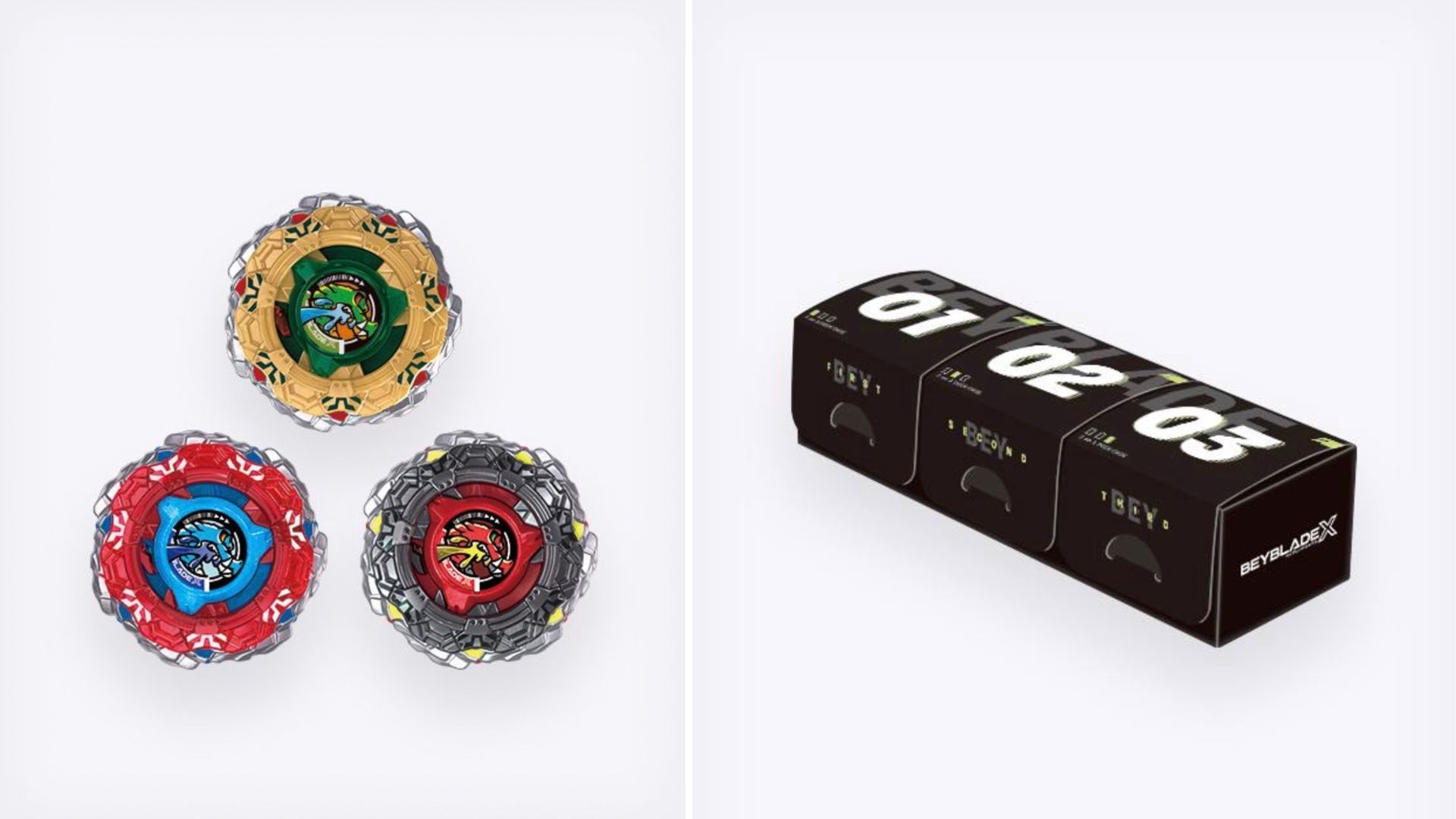
The Beyblade X GP Cup @ Bugis+ Atrium also saw the launch of new boosters and deck cases | IMAGE: BEYBLADE SINGAPORE
For me, it was refreshing to see children getting excited about something that doesn't require a screen. If you've watched Toy Story 5 recently, you'd know the fear that we are raising a generation of sedentary kids fixated on their mobile devices.
Don't get me wrong. I grew up with Game Boys and PS2s, and I'm hardly going to start pretending I didn't spend ridiculous amounts of time playing video games. But Beyblade offered the joy of playing outside.
That's the part of the Beyblade revival that makes me happiest. Not simply that an old childhood toy has returned to reel in the nostalgia, but that a new generation is finding a reason to gather around something physical and experiential.
Maybe some of these kids will eventually outgrow Beyblade, just like me. But I hope before they get there, they'll experience what I did: the simple joy of playing an analogue toy with friends.
For the latest updates on Wonderwall.sg, be sure to follow us on TikTok, Telegram, Instagram, and Facebook. If you have a story idea for us, email us at [email protected].