
.jpg?sfvrsn=99a01a76_1 "DO NOT DELETE 3-image collage (5)")
Inside Haji Yusoff Memorial Museum: The Singapore Story Behind The Haj Belt
I have probably walked past Gedung Kuning in Kampong Gelam more times than I can remember.
But until recently, I had no idea that the yellow mansion was once home to Haji Yusoff Mohamed Noor—a Singapore-born Malay businessman believed to have created the first Haj utility belt for pilgrims. Nor did I know that a museum preserving his family’s history now sits nearby, directly opposite Masjid Sultan.
The striking mansion dominates the streetscape alongside Masjid Sultan, also known as Sultan Mosque, and the Malay Heritage Centre. As a Malay Singaporean millennial who grew up in the 2000s, this was familiar territory. My knowledge of its history and former residents, however, was superficial at best.
Granted, I might have had an occasional Ramadan iftar at Permata, the Nusantara restaurant currently housed in Gedung Kuning. I even remember checking out Amazing Chambers Singapura, the short-lived history-themed escape room that once operated there.
But ask me who Haji Yusoff was and, until recently, I would have drawn a blank. That ignorance became particularly ironic when I realised that I had worn a version of his most famous creation during my own umrah.
So, when my partner told me about an event marking the third anniversary of the Haji Yusoff Memorial Museum, I was immediately intrigued. It was time to uncover a lesser-known chapter of Singapore’s Malay history right at its source.
Who was Haji Yusoff, the pioneer behind the Haj Belt?
Haji Yusoff Mohamed Noor was born in Singapore in 1855. He was a businessman, community leader and philanthropist, and became known as Haji Yusoff Tali Pinggang (Haji Yusoff, belt merchant) thanks in part to his hugely successful Haj Belt business.
But his beginnings were much more modest. He learnt to sew and started by making songkok. After performing Hajj in 1880 at the age of 25, he returned with an idea: a belt with a small pouch that male pilgrims could use to carry their belongings.
You see, during Hajj, male pilgrims are only allowed to wear two pieces of white, unstitched cloth without pockets. Haji Yusoff saw a practical problem and, using a skill he already possessed, created a solution.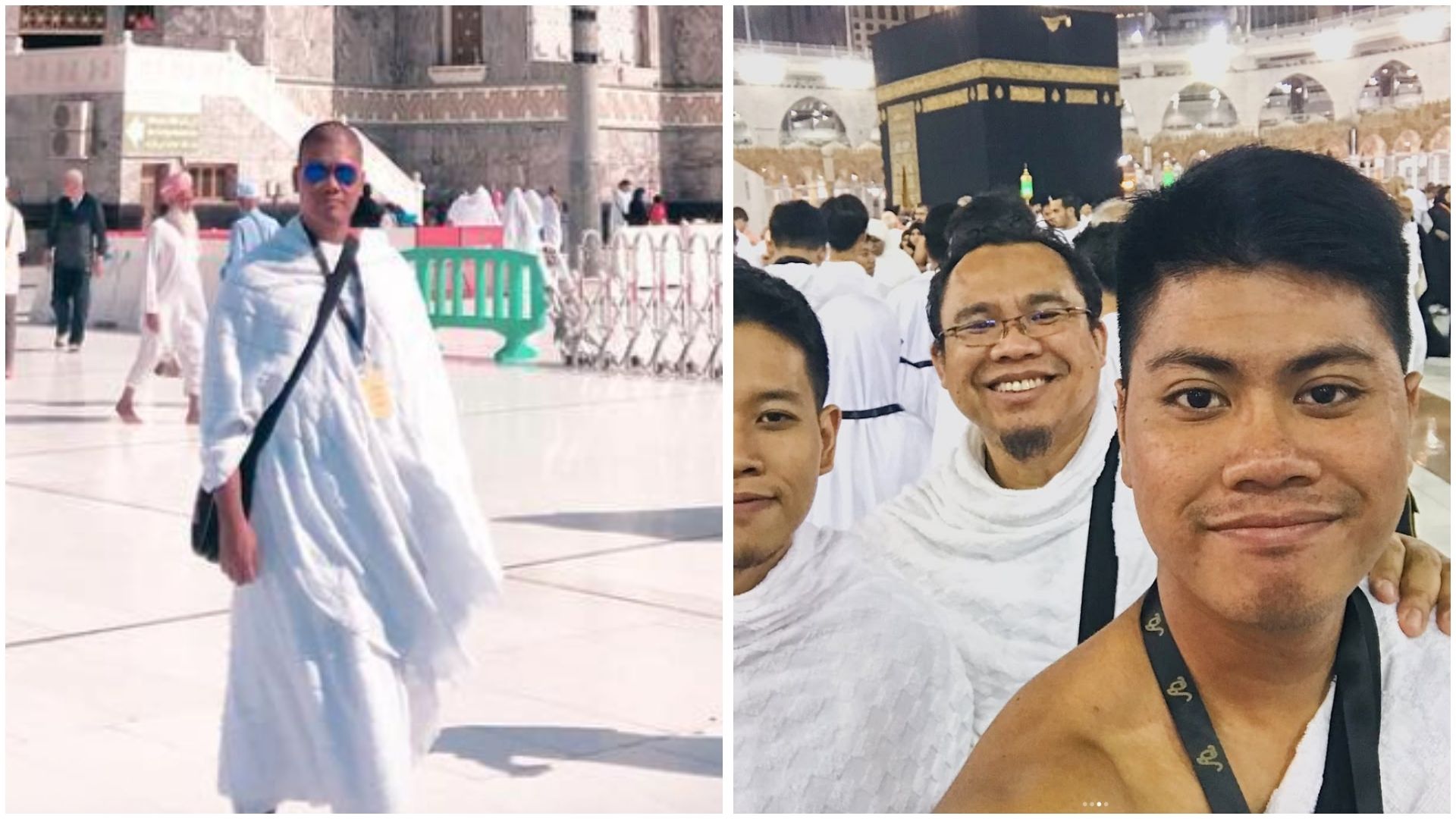
You can't see the belt, but it's what's keeping my bottom garment up to my waist | IMAGES: FARHAN SHAFIE
When I performed umrah or the minor pilgrimage nearly a decade ago back in 2017, I wore a similar belt to keep my ihram garment in place as I was circling the Kaaba. I’ve always assumed it was a standard part of the outfit that you get from your Hajj agency. You know, like your standard issue SAF army uniform. I had no idea that the original Hajj Belt had such an interesting backstory.
Its origins could be traced to the Singaporean Malay pioneer, the former resident of Gedung Kuning, and whose family lived there for four generations up until 1999.
The man’s entrepreneurial legacy stretched across Singapore and the wider Malay archipelago from the 19th century all the way to the present day. The prospect of learning about the history of the Haj belt definitely sparked an innate curiosity, triggered by my own experience wearing a version of it all those years ago.
How a family loss became a mission to preserve history
The Haji Yusoff Memorial Museum is located on the third floor of nearby 717 North Bridge Road, directly opposite Masjid Sultan.
That address is significant. The shophouse was another property owned by Haji Yusoff's family, and it had once been his workshop, where he sewed songkoks and created the Hajj Belts that would become his trademark.
As I traipsed up the stairs of this nondescript shophouse unit, I could almost feel the weight of history with each step. Entering the lofted space, I came across Haji Yusoff’s great-granddaughter, Hidayah Amin, who was in the middle of a curated tour. Hidayah's own story is almost as compelling as her great-grandfather's.
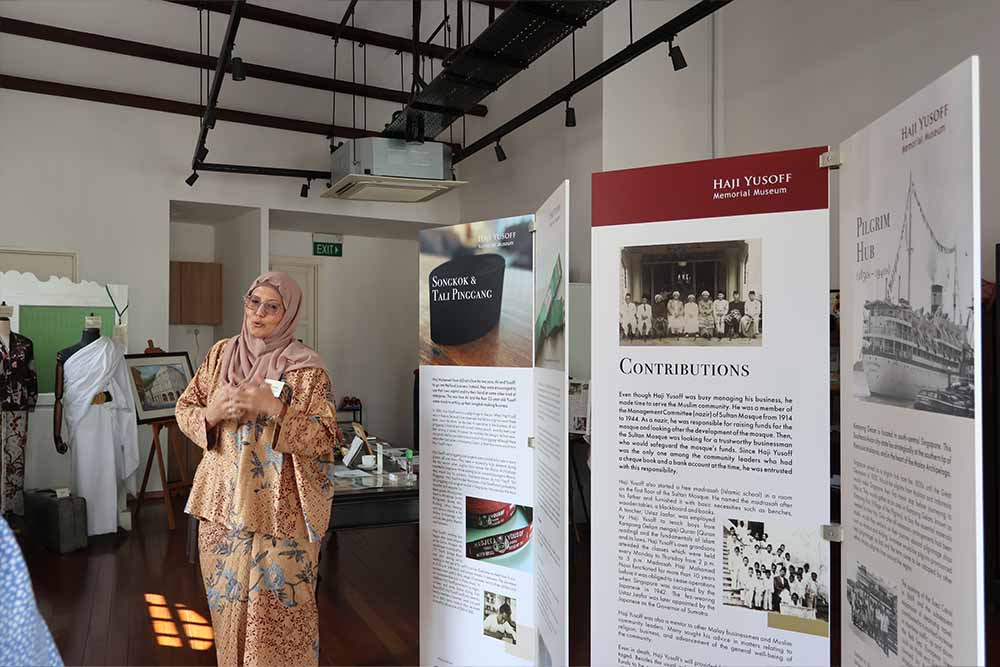
IMAGE: IFFAH HAMAD
She was born in Gedung Kuning in 1972 and grew up there, in what was essentially her family home. Then, in 1999, the Government acquired the property as part of the redevelopment of the area. For Hidayah, losing the home where she had spent almost three decades was deeply personal. She described feeling as though a piece of herself had been taken away.
That loss pushed her towards writing. Her first book, Gedung Kuning: Memories of a Malay Childhood, published in 2010, documented her memories of growing up in the mansion.
Her late mother encouraged her with a sentence that would eventually become something of a guiding philosophy: “If we don’t write our own story, then someone else will write our story for us.”
It is difficult not to see that sentence as the thread connecting everything Hidayah has done since. This led to the creation of the museum.
Inside Haji Yusoff Memorial Museum
Walking into it felt less like entering a conventional museum and more like being invited into someone's family home, because in many ways, that is exactly what it is.
There are family photographs, household objects, business materials and heirlooms.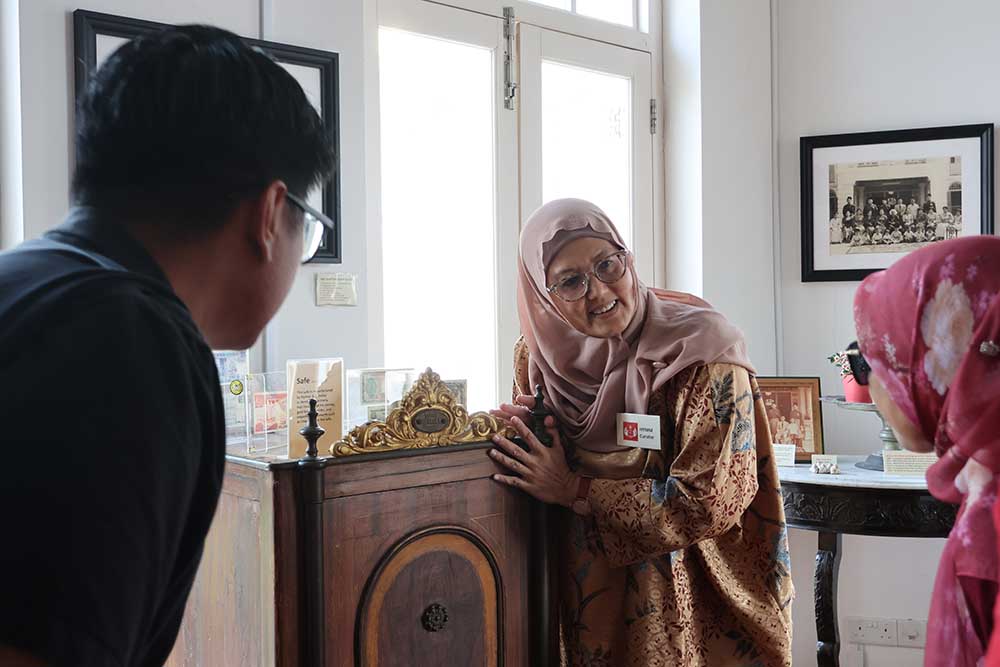
IMAGE: IFFAH HAMAD
Among the most impressive objects is a massive pre-First World War safe (pictured above), made in Germany, easily weighing around 200kg. It’s a testament to Haji Yusoff’s vast network of connections that he was able to ship such an item to Singapore even back then.
There were also spools and materials associated with the production of Hajj Belts. These are not just abstract historical artefacts. They were handled by members of a family that lived through several generations of Singapore's transformation.
Some of the items were among the 46 family artefacts loaned to the Malay Heritage Foundation when the Government acquired Gedung Kuning in 1999. Hidayah has spoken publicly about her subsequent frustration over the condition and return of those artefacts, and her determination to bring them back under her family's care.
That history gives the museum an emotional weight that I don't think I would have appreciated from reading about it online. Haji Yusoff made enough from his businesses to purchase the Gedung Kuning residence in 1912 for $37,000 in cash (all you budding economists, do the math on what that’s worth today, factoring in inflation).
He would also donate regularly to Masjid Sultan and contributed to the community around Kampong Gelam. Hidayah shared that, despite Haji Yusoff’s riches and influence, at his core, he considered himself an ordinary man.
When Kampong Gelam was a regional pilgrimage hub
Haji Yusoff’s belts were sought after by pilgrims travelling through Kampong Gelam, which was not merely a pilgrimage hub for Singaporeans but a gathering point for Muslims from across the region. Hidayah described her great-grandfather as a man with vision and foresight who cared about quality. His business eventually became so synonymous with the product that he was known as Haji Yusoff Tali Pinggang.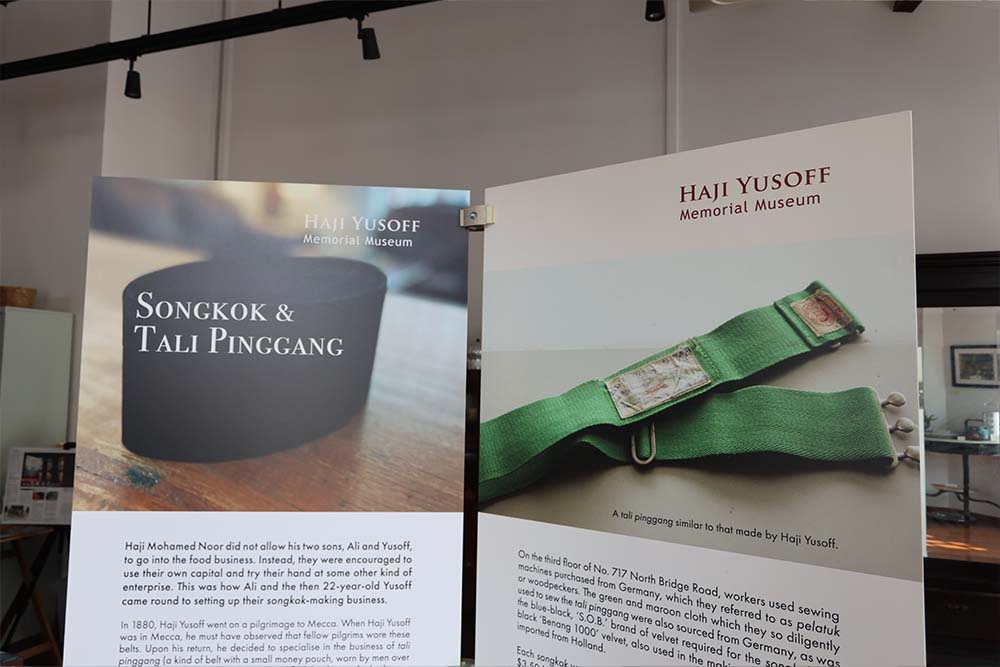
IMAGE: IFFAH HAMAD
Hidayah explained that her great-grandfather's creation became so successful that there were eventually others selling similar belts, including people making claims about their own connections to the product. In a way, he was building a Singapore brand long before “Made in Singapore” became a tourism slogan we would consciously market.
I found the whole concept of pre-independent Singapore already being a thriving hub of commerce, migration and religious travel absolutely fascinating. Even during that era, there were Malay Singaporeans who led the community as entrepreneurs and business owners.
I had always thought of Kampong Gelam primarily through its present-day identity: heritage buildings, Muslim culture, restaurants, boutiques, cafes and a tourism hotspot.
But Hidayah's research paints a much bigger picture. Her 2019 book Leluhur: Singapore's Kampong Gelam won the $50,000 NUS Singapore History Prize in 2021 and explores the area's evolution into a cosmopolitan economic, religious and intellectual hub of the Malay world. The book also challenges the simplistic idea that Kampong Gelam was merely a settlement of Malay royalty, highlighting instead the diversity of people who lived and worked there.
During my afternoon with Hidayah, I learnt more about Kampong Gelam’s role as a pilgrimage hub for people across Southeast Asia. Before air travel became commonplace, pilgrims from the region would gather here before making the journey to Mecca by sea. I wondered how many other young Singaporeans like me had never really been taught to see it that way.
Watching her talk about Haji Yusoff, I could see that this was not just an academic subject for her. There was pride and frustration. There was also a sense of responsibility.
She told me that growing up, she felt the stories she encountered about Malay Singaporeans often focused on fishermen, policemen, postmen and sailors.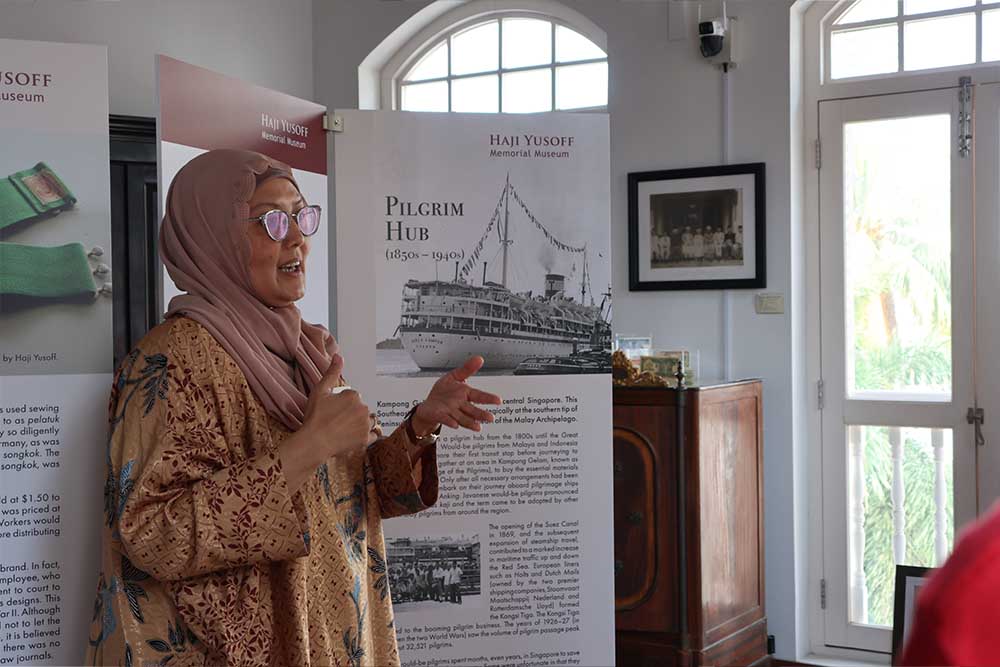
IMAGE: IFFAH HAMAD
There was nothing wrong with those stories, she stressed. But where were the stories of the Malay merchants? Where were the entrepreneurs? Where were the community leaders?
Where were the people who had accumulated wealth, built businesses and contributed to Singapore's development? Hidayah's research into her own family eventually revealed that Haji Yusoff belonged to this less-discussed Malay mercantile class. And there was another detail I found particularly fascinating. Haji Yusoff apparently had opportunities to accept recognition from the British, including titles and other forms of prestige, but chose not to pursue them.
His attitude reflected something Hidayah believes has sometimes made Malay contributions less visible: humility. The philosophy of not boasting about what you have done can be admirable.
But it can also mean that future generations simply never hear about what was done. As Hidayah told me during our interview, "Just because you do not know how much the person contributed doesn't mean the person did not contribute."
The lesson Haji Yusoff left for young Singaporeans
At the end of our conversation, I asked Hidayah what she hoped younger Singaporeans would take away from her great-grandfather's story.
She emphasised the importance of purpose and that helping others succeed does not make you less successful. Haji Yusoff built a business because he wanted to make something useful. But his success did not stop with himself.
He supported his community. He mentored other Malay businessmen. He became part of the fabric of Kampong Gelam and, in his own way, Singapore's story. Hidayah made another point that stayed with me: Your knowledge does not become smaller because you share it. For a generation that is constantly encouraged to build personal brands, maximise careers and chase individual success, there is something refreshingly old-fashioned about that lesson.
Haji Yusoff’s legacy represented an entire chapter of Singapore's history, one that I had somehow managed to walk past for most of my life. More importantly, I learnt about the responsibility of remembering.
Hidayah has spent years writing, researching, collecting and preserving because she believes our stories deserve to be told by us. And perhaps that is the lesson I would pass on to other young Singaporeans of my generation.
Look again at the places you think you know. Ask who built them, who lived there, and whose stories have disappeared.
Haji Yusoff may have built an empire with a thread. His great-granddaughter is now making sure the thread doesn't get lost.
How to visit the Haji Yusoff Memorial Museum
- Address: 717 North Bridge Road, Level 3
- Opens one Saturday a month, 12pm to 6pm, with free entry
- Check the Haji Yusoff Memorial Museum's Instagram page for open house dates
For the latest updates on Wonderwall.sg, be sure to follow us on TikTok, Telegram, Instagram, and Facebook. If you have a story idea for us, email us at [email protected].