




This National Monument Was Struck By Lightning In The Same Spot... Twice ⚡
If you’ve spent any time around City Hall, chances are you already know that unmistakable white spire – even if you’ve never actually stepped inside the building it belongs to.
And I don’t blame you. With Raffles City, the National Gallery and a whole bunch of other places to get to around the area, St Andrew’s Cathedral might just be another familiar landmark in the background. But stepping inside? A completely different experience.
Beyond its grand architecture, there’s also the rather incredible story of how the spire of the church that originally stood here was struck by lightning. Not once, but twice.
With St Andrew’s Day (30 Nov) just around the corner, what better time to take a closer look at Singapore’s largest cathedral?
Overview
- Official name: St Andrew's Cathedral
- Address: 11 St Andrew's Rd, Singapore 178959
- Present cathedral built: Construction began in 1856; the first service was held in 1861
- Architectural style: Early English Gothic (Neo-Gothic)
- Current use: Active Anglican cathedral and mother church of the Anglican Diocese of Singapore
- Year gazetted as a National Monument: 28 Jun 1973
- Nearest MRT station: City Hall (Exit B)
- Admission: Free
- Opening hours: Daily, 7am-8pm
- Guided tours: Free, with advanced booking required
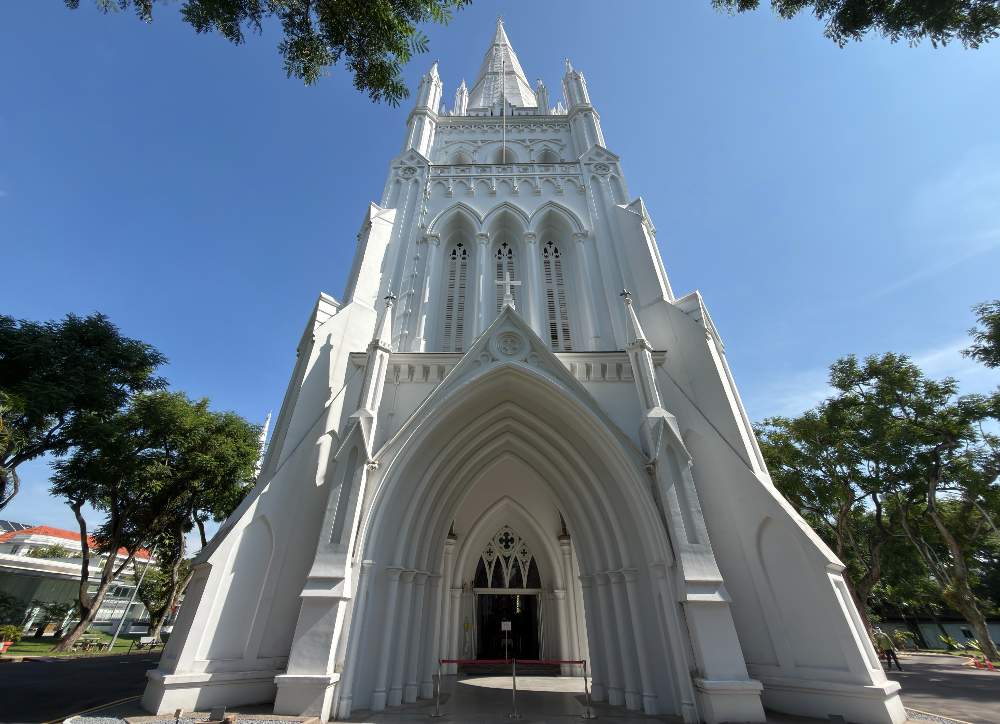 IMAGE: NG KAI
Why St Andrew’s Cathedral is worth stepping inside
St Andrew’s Cathedral is Singapore’s oldest surviving Anglican place of worship and its largest cathedral. It was also among the first eight National Monuments gazetted in Singapore on 28 Jun 1973.
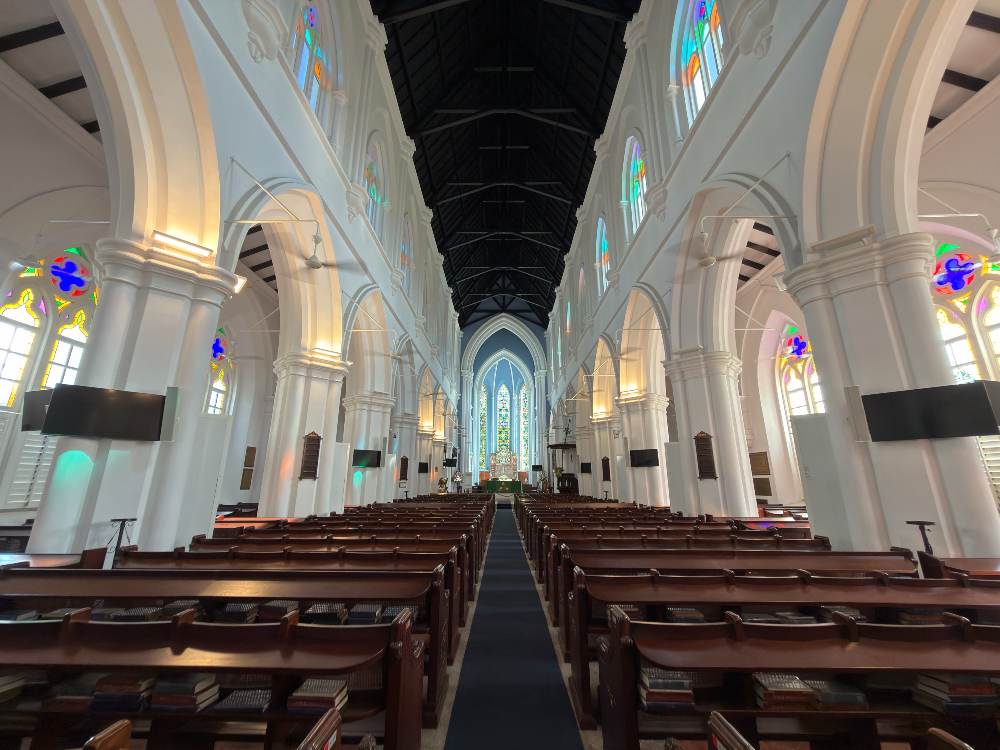
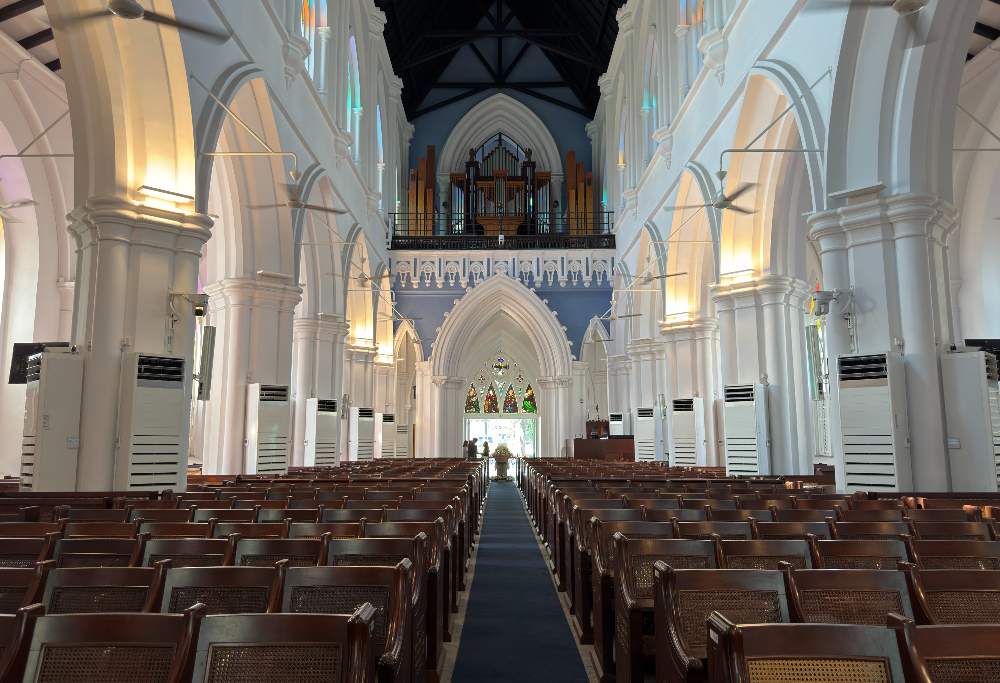
But impressive as it is from the outside, I’d argue that the interior is where you really appreciate the scale of the building. My first thought upon stepping inside was probably the least sophisticated architectural observation ever: the ceiling is so, so high.
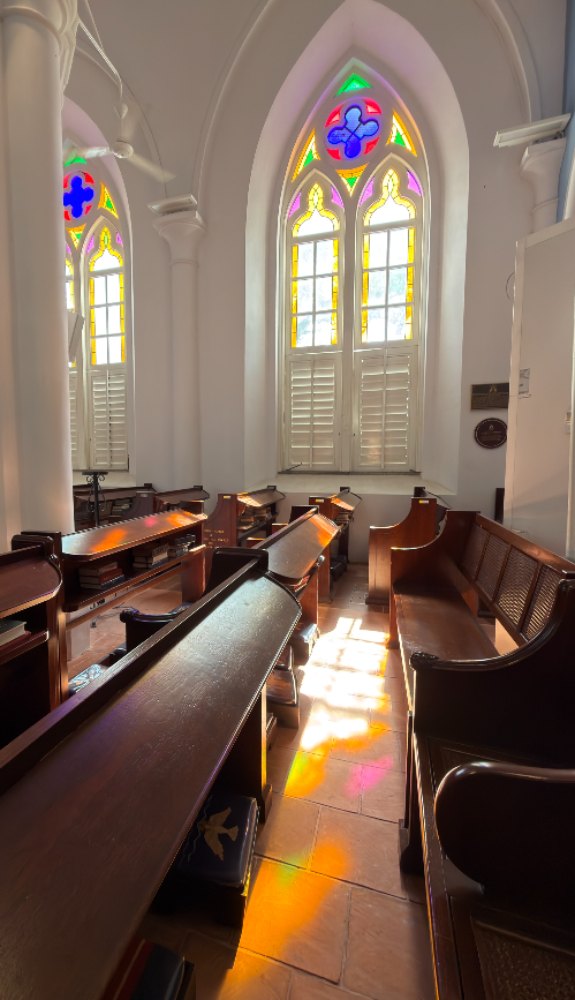
IMAGE: NG KAI
Everything feels incredibly grand. And when the sunlight streams through the stained-glass windows, the colours are especially pretty against the predominantly white interior. It’s one of those spaces where photos and videos don’t quite do justice to how impressive it feels in person.
So why is a cathedral in Singapore named after Scotland’s patron saint?
Plans for an Anglican church in Singapore date back to the early 1820s, when Sir Stamford Raffles allocated land for one in the town plan.
In 1834, funds were raised to construct the church, with substantial contributions coming from the local Scottish community. In recognition of their generosity, the church was named after St Andrew, one of Jesus Christ’s 12 apostles and the patron saint of Scotland.
The original building was designed by George D. Coleman (who also designed the Armenian Church, another National Monument), and held its first service on 18 Jun 1837.
Lightning really does strike the same place twice
In 1842, government surveyor John Turnbull Thomson added a tower and spire to the church. There was just one rather glaring oversight: no lightning conductor had been installed.
In 1845, lightning struck the spire. And in 1849, it happened again. You’d think that after the first lightning strike, installing a lightning conductor would have been pretty high up on the to-do list.
Well, one was eventually installed – but only after the second lightning strike. Unfortunately, the building was eventually deemed unsafe, closed in 1852 and demolished in 1855.
The cathedral we know today was built by Indian convict labourers
Construction of the present-day building began in 1856, based on a design by Lieutenant-Colonel Ronald MacPherson. Much of the construction was carried out by Indian convict labourers.
The new church held its first service on 1 Oct 1861 and was consecrated in Jan 1862, although construction work continued for several more years.
In 1870, St Andrew’s Church attained cathedral status, becoming the cathedral of the Diocese of Labuan and Sarawak. When the Diocese of Singapore was established in 1909, it became the cathedral of the new diocese.
And while the architecture might be distinctly European, the people responsible for bringing it to life included labourers from India – another reminder of how many of our colonial-era buildings were shaped by the contributions of different communities.
This cathedral once doubled as an emergency hospital
In Feb 1942, during the Battle of Singapore, the cathedral and its grounds were used as an emergency hospital to accommodate and treat the wounded. Remarkably, Sunday worship services continued throughout the Japanese Occupation from 1942 to 1945.
IMAGES: NG KAI
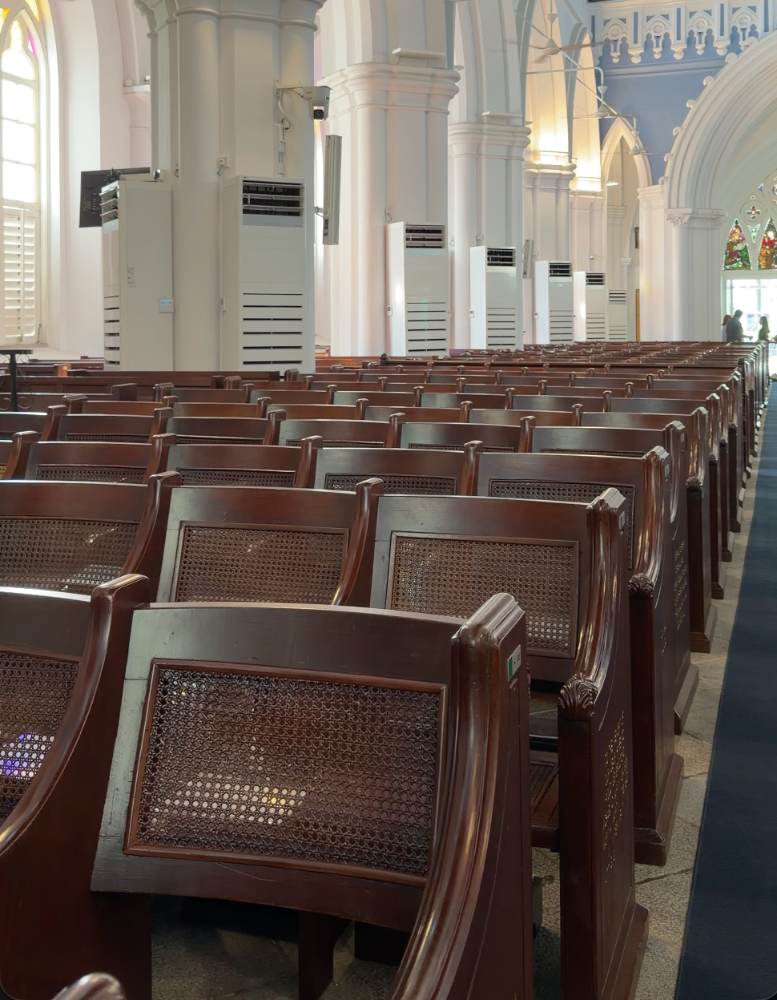
Standing inside the cathedral today, surrounded by rows of wooden pews in what is a profoundly peaceful space, I find it quite difficult to picture the scenes that must have unfolded here in 1942. It’s a sobering reminder of just how much history some of our most familiar buildings have witnessed.
What to look out for when you visit
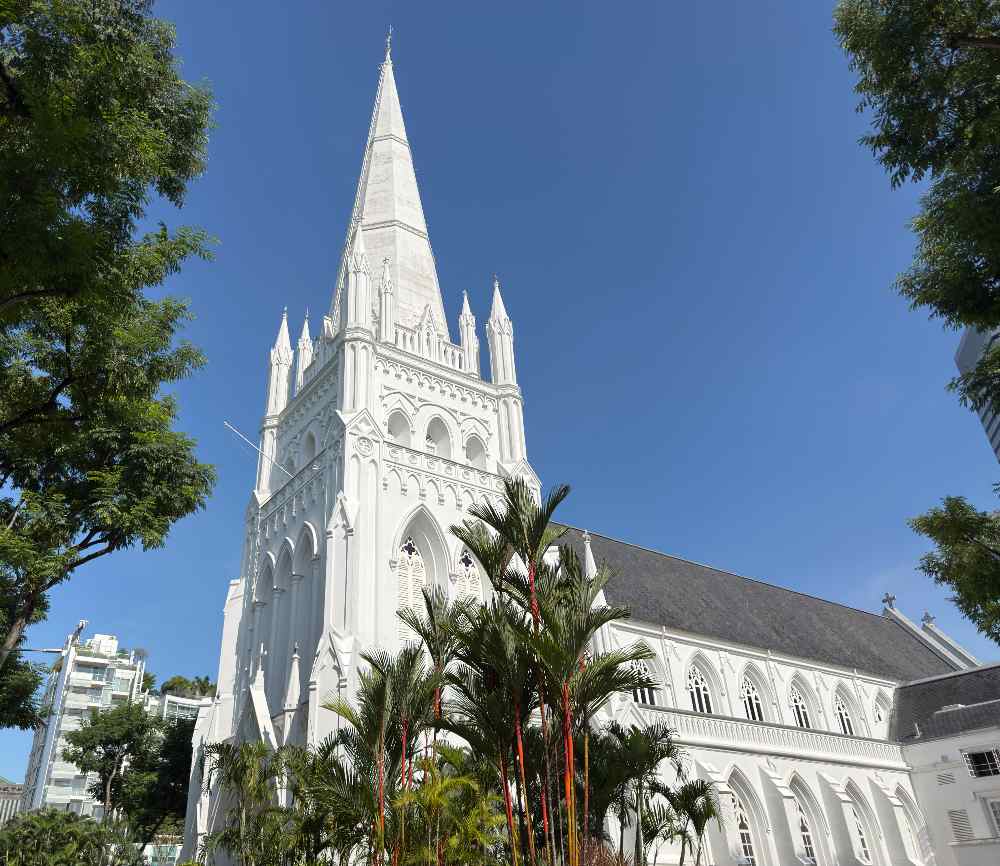 IMAGE: NG KAI
That unmistakable white spire
There’s no mistaking St Andrew’s Cathedral for anything other than a Gothic-style building. Its pointed arches, slender windows, elaborate architectural details and towering spire are characteristic of Early English Gothic architecture.
The cathedral measures approximately 69m in length and 36m in width, while its iconic spire rises some 63m above the ground.
It’s probably the architectural feature most of us recognise from afar, but take some time to appreciate the other details on the façade when you’re actually standing in front of the building.
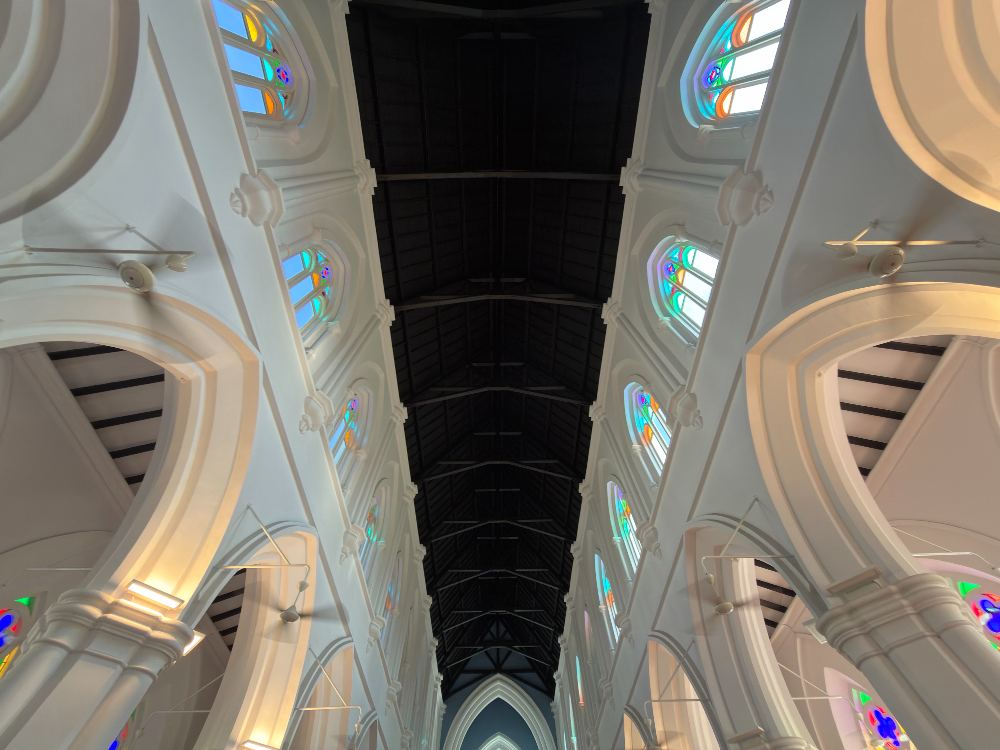 IMAGE: NG KAI
The ridiculously high ceilings
The long central section of the church (known as the nave) is flanked by rows of arches and columns that naturally draw your eyes upwards. High above them are clerestory windows – essentially windows positioned high up on the walls – that allow natural light to enter the interior.
What I particularly like about the interior is how grand it feels without being excessively ornate. The predominantly white surfaces, soaring arches and abundance of natural light make the space feel remarkably airy.
And if you’re wondering why everything looks so pristine for a building that’s more than 160 years old, the cathedral’s nave underwent extensive restoration works that were completed in 2023.
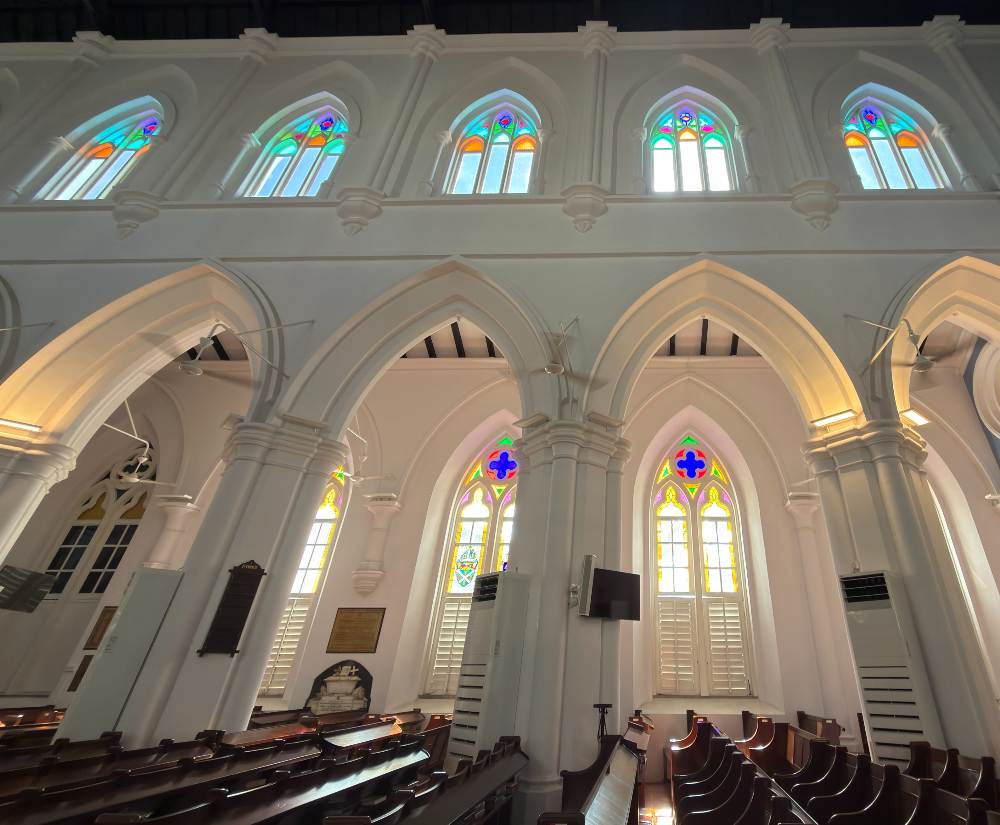 IMAGE: NG KAI
Those gorgeous stained-glass windows
If there’s one thing I’d recommend doing here, it’s visiting on a sunny day.
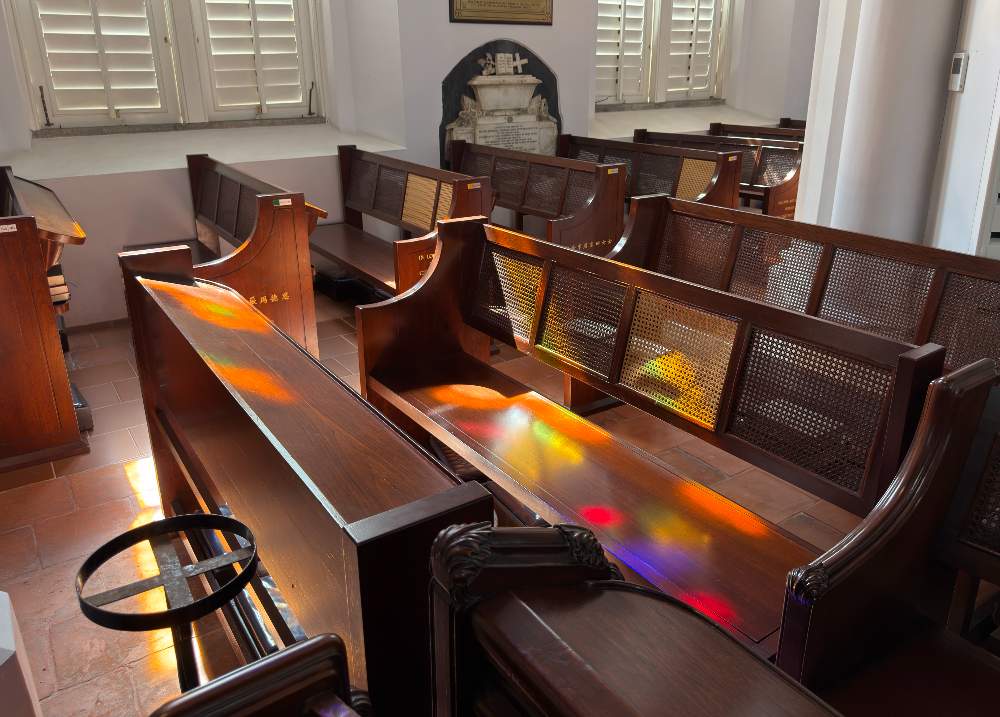 IMAGE: NG KAI
One of my favourite sights inside the cathedral was the sunlight streaming through the stained-glass windows. There’s something especially pretty about seeing all those vibrant colours against the browns and whites inside.
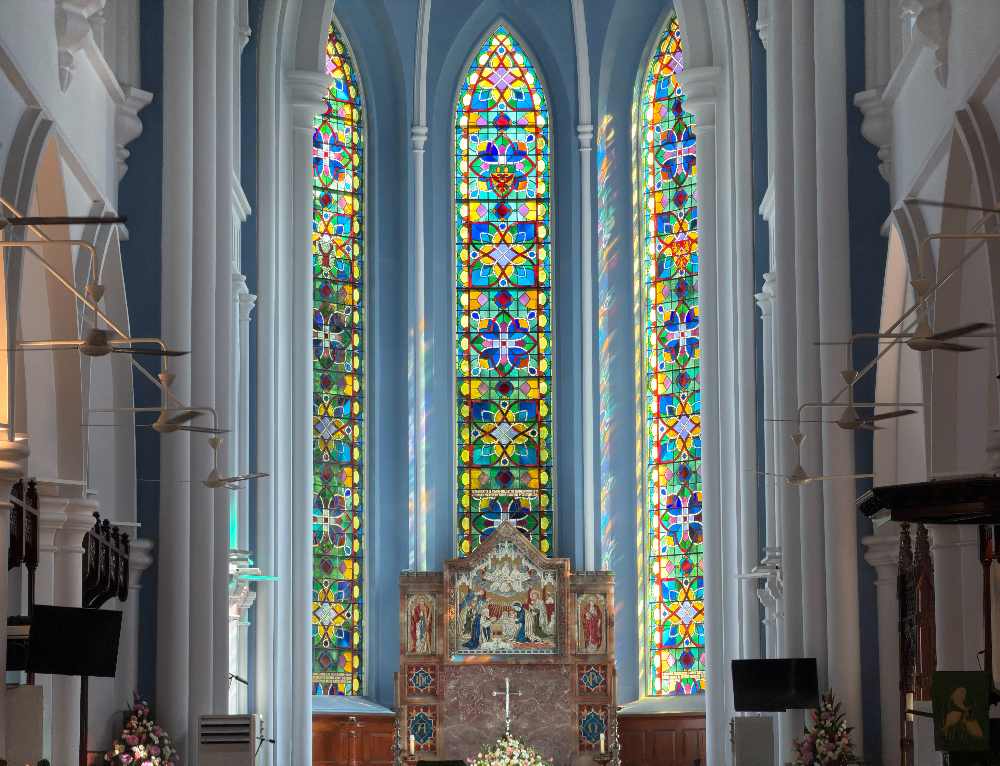
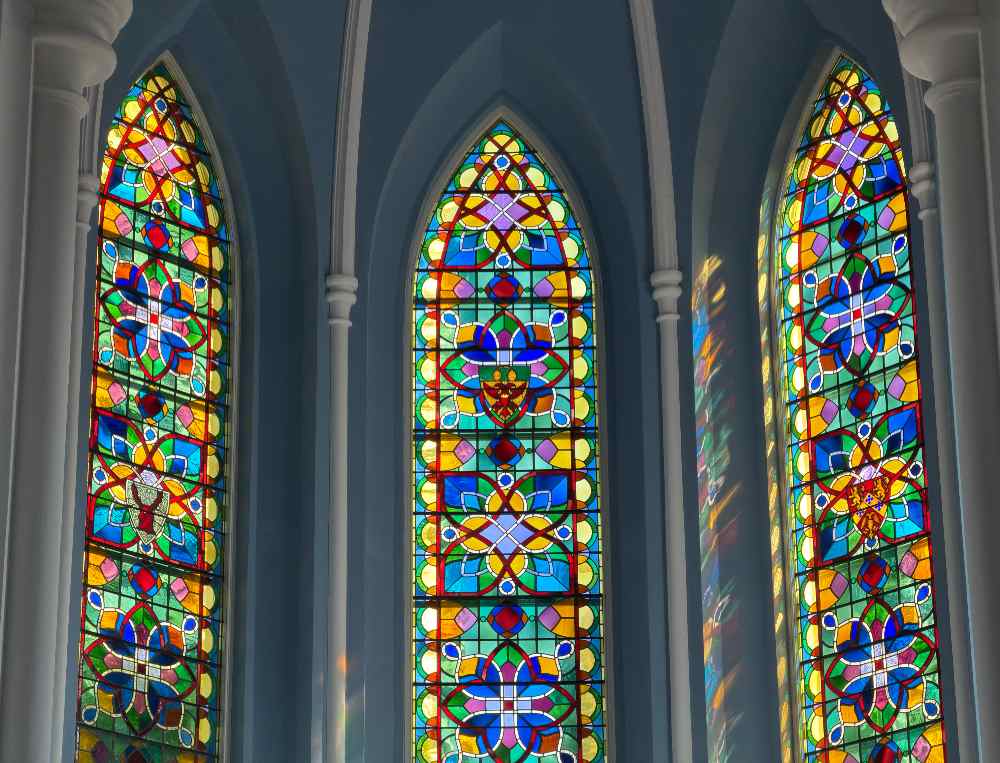 IMAGES: NG KAI
The three prominent stained-glass windows at the eastern end of the cathedral commemorate three figures from Singapore’s colonial history:
- Sir Stamford Raffles (centre window)
- John Crawfurd, Singapore’s second British Resident (left window)
- Major-General William Butterworth, a former Governor of the Straits Settlements from 1843-1855 (right window)
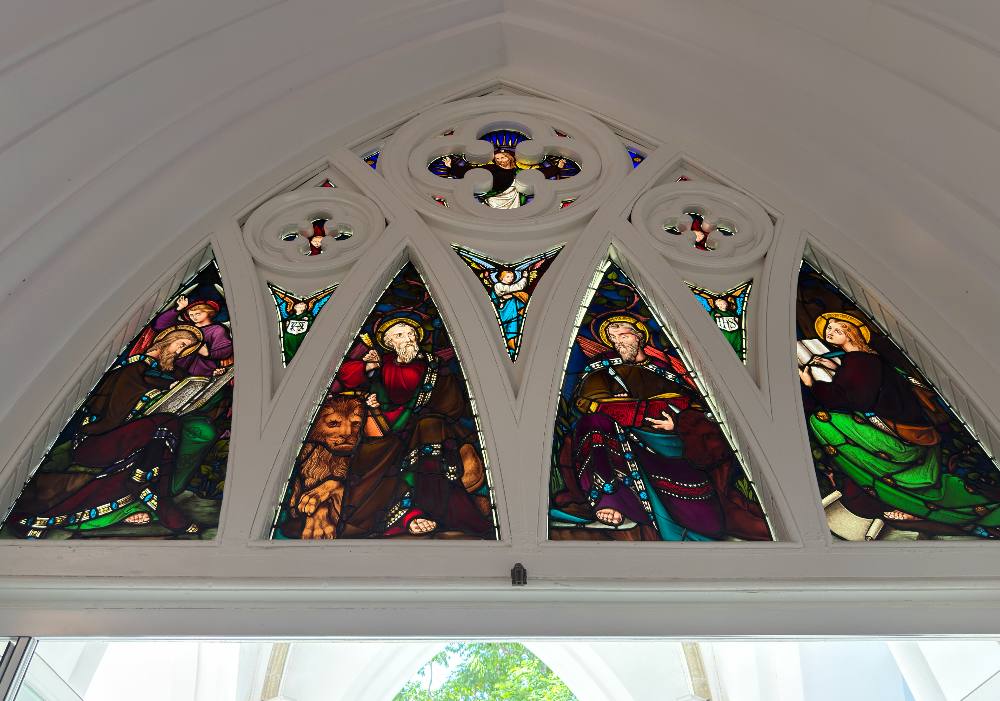 IMAGE: NG KAI
Also, don’t forget to turn around and look above the main entrance. There’s another stained-glass window depicting the four Gospel writers – Matthew, Mark, Luke and John – which commemorates Ronald MacPherson, the architect of the building.
Basically, spend less time looking at your phone and more time looking up (unless, of course, you’re using your phone to take photos of the windows).
 IMAGES: NG KAI
The pipe organ
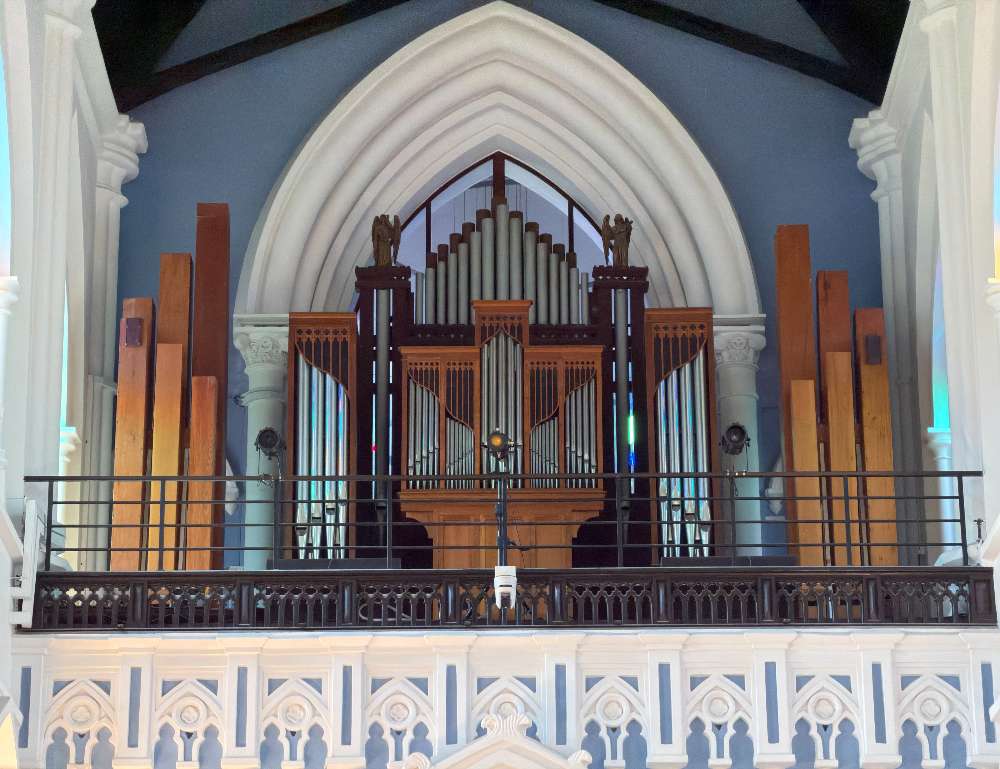
Before leaving, look up towards the gallery above the main entrance. The first pipe organ in the present cathedral was installed in 1861, and remarkably, some pipes from that very instrument have survived to this day.
Following a major restoration and reconfiguration completed in 2019, the cathedral’s organ now combines historic pipes, newly installed pipes and modern electronic technology, all controlled from a single console.
Imagine hearing music produced by pipes that are more than 160 years old; old-school meets new-school, literally.
Why not go National Monument-hopping while you’re here?
One thing I’ve come to appreciate while exploring Singapore’s National Monuments is just how many of them are within walking distance of one another – particularly in the Civic District.
In fact, within a short walk of St Andrew’s Cathedral, you’ll find:
- The Civilian War Memorial: A poignant tribute to the civilian victims of the Japanese Occupation.
- The Padang: The site of some of the most significant moments in Singapore’s history.
- The Former City Hall: Where the Japanese formally surrendered to the British in Singapore in 1945.
- The Former Supreme Court: Together with the Former City Hall, it now houses National Gallery Singapore.
- The Former Parliament House (now The Arts House): Believed to be Singapore’s oldest surviving building, dating back to 1827.
- The Former Empress Place Building: Now home to the Asian Civilisations Museum.
Come to think of it, you could easily spend an entire afternoon National Monument-hopping without straying very far from City Hall MRT station. And considering how often many of us head to City Hall just to makan or shop, why not switch things up a little the next time you’re in the area?
Play tourist in your own country for an afternoon. You might be surprised by how much you’ve been missing in a part of Singapore you thought you knew pretty well.
Thinking of visiting St Andrew’s Cathedral?
Some of our National Monuments require a little more effort to get to, but this one is practically at the doorstep of an MRT station in the middle of town. And admission is free.
If you’d like to learn more about the building, the cathedral also conducts free, one-hour guided heritage tours:
- Tuesdays: 11am (English)
- Wednesdays: 10am (Chinese)
- Thursdays: 11am (English)
Each regular tour accommodates a maximum of six participants, and advance booking is required. Tours are not conducted on public holidays.
The Cathedral Welcome Centre is open from 10am to 4pm, Tuesdays to Saturdays, and closes on selected public holidays.
Just remember that this is first and foremost an active place of worship. Dress respectfully, keep your voice down and avoid disrupting religious services. Access to certain areas, or the entire cathedral, may also be restricted during services and special events.
And if you’re planning a proper filming or photography shoot, seek permission from the cathedral beforehand. Restrictions apply, particularly to organised indoor shoots.
Wait, what makes something a National Monument?
In Singapore, National Monuments are buildings, structures or sites recognised for their national significance and value to our built heritage. They are gazetted by the Preservation of Sites and Monuments, a division of the National Heritage Board, which is why the title is reserved for places that carry especially important historical, architectural, social or cultural meaning.
As of 2026, Singapore has 77 National Monuments. Some are obvious landmarks, like the Padang, the Civilian War Memorial and Fort Siloso. Others are places you may have walked past without a second thought, which is exactly why this series exists.
One National Monument at a time, we’re here to uncover the stories hiding in plain sight.
For the latest updates on Wonderwall.sg, be sure to follow us on TikTok, Telegram, Instagram, and Facebook. If you have a story idea for us, email us at [email protected].