

This National Monument In The CBD Is Singapore’s Famous “Temple Of Love”
Yueh Hai Ching temple in Singapore is a National Monument in the heart of Raffles Place, but it’s also famous for something less corporate: helping people find love.
While heading to One Raffles Place for a salad lunch the other day, I realised the temple was just around the corner. Now, I’m already married, so no, I wasn’t looking for divine intervention.
But I was curious: why has this nearly 200-year-old Taoist temple become such a legendary spot for singles? The answer involves an old man, goated matchmaking skills, and a whole lot of red thread.
Overview
- Official name: Yueh Hai Ching temple (粤海清庙), also known as "Wak Hai Cheng Bio" in Teochew
- Address: 30B Phillip Street, Singapore 048696
- Built: The present-day temple was constructed in 1852-1855, but its roots can be traced back to the 1820s
- Current use: Taoist temple and place of worship
- Year gazetted as a National Monument: 1996
- Nearest MRT station: Raffles Place
- Admission: Free
- Opening hours: 8am-5pm daily, including public holidays
Why Yueh Hai Ching temple is worth a visit
The first thing that struck me was the contrast. Surrounded almost completely by glass-and-steel CBD skyscrapers is this ornate temple filled with incense, carved timber and colourful ceramic figures.
If you work around Raffles Place, it’s surprisingly easy to walk past without realising that one of Singapore’s oldest Chinese temples is sitting right there.
And unlike some heritage buildings that now serve completely different purposes, Yueh Hai Ching temple is still a living place of worship. People enter to pray for health, blessings and, famously, love.
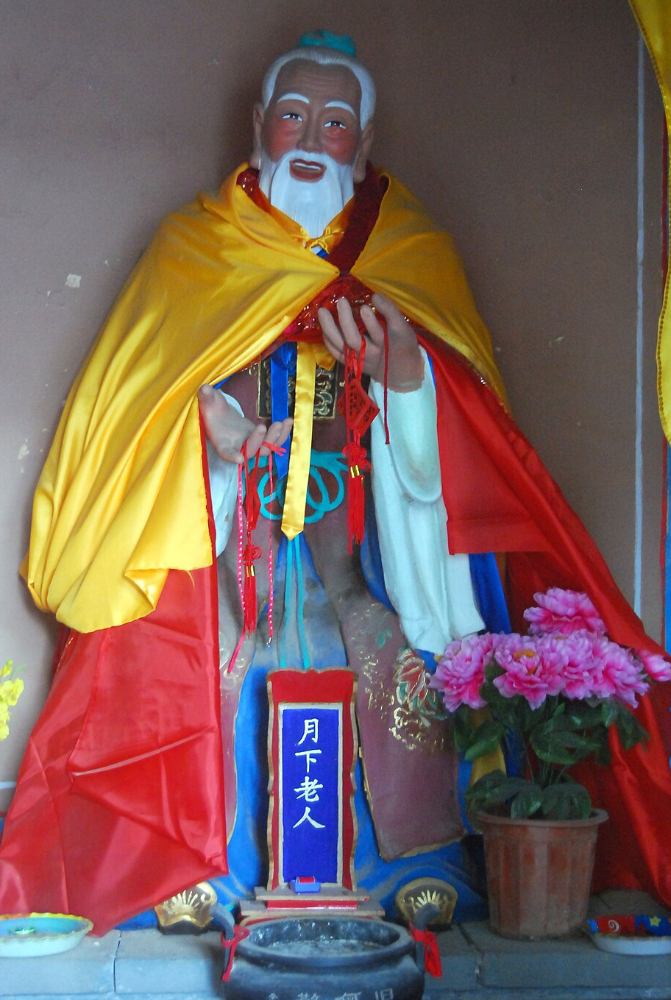
IMAGE: WIKIMEDIA COMMONS/@SHIZHAO
Meet Yue Lao, the Chinese God of love and matchmaking
One reason the temple has earned its “Temple of Love” nickname is Yue Lao (月老), the Chinese deity of love and matchmaking.
His name means the “Old Man Under the Moon”; and according to Chinese folklore, Yue Lao connects people destined to be together with an invisible red thread, no matter how far apart they may be. That explains all the red strings around his shrine.
There are other temples in Singapore where Yue Lao is worshipped, but the deity here has developed a particularly strong reputation among devotees seeking relationships and marriage. Whether that comes down to destiny, faith or excellent word-of-mouth – only the successful matches will know.
Has Yue Lao actually helped people find love?
Singles, I can't promise a lunchtime visit will have your soulmate waiting outside your office door by the end of the working day. But, there are some pretty convincing testimonials of Yue Lao's matchmaking prowess.
In 2016, Mah Chun How and Kang Say See became the first couple to solemnise their marriage here following the temple’s restoration. Both had separately prayed to Yue Lao before relatives introduced them to each other, without knowing the other had done the same. They later returned to marry at the temple on Yue Lao’s birthday.
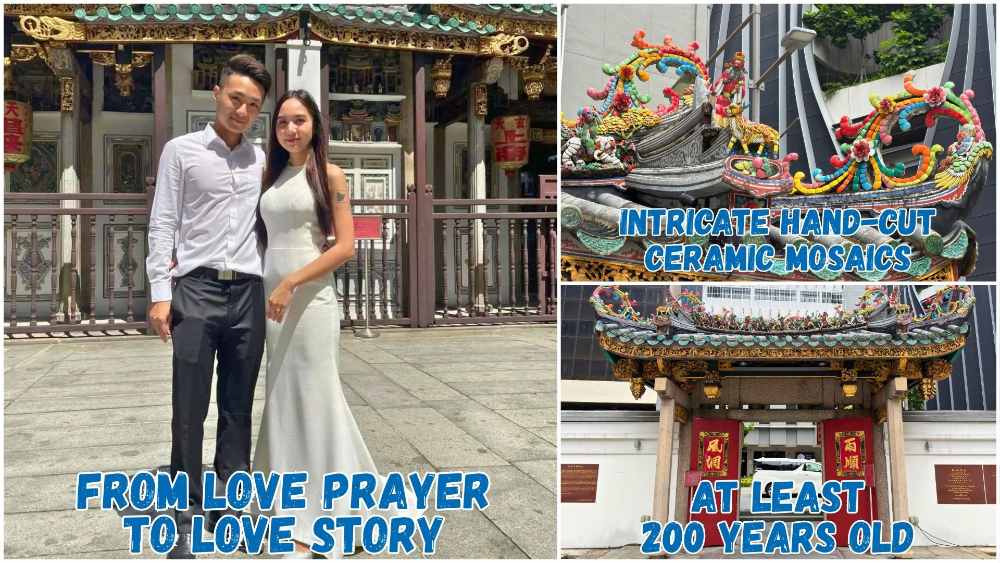
In 2022, Pimmada, a 23-year-old Thai woman, visited Yueh Hai Ching temple while holidaying in Singapore and prayed to Yue Lao for a partner before returning home. Two months later, she met Singaporean Yang Zi Hao, then 28, at a friend’s gathering in Thailand.
Despite a language barrier – Pimmada spoke Thai while Yang relied partly on Google Translate and basic Thai – the pair started dating and decided to marry about six months later. They subsequently returned to Singapore for their marriage registration and made another trip to the temple to offer their thanks.
So, if the usual lineup of run clubs, dating apps, and singles' mixers have borne little success for you... maybe it's time to make a wish to the Old Man Under the Moon at Yueh Hai Ching temple.
Before Yueh Hai Ching became the “Temple of Love”
Nobody can say when the temple was first built.
Teochew immigrants originated from the Chaoshan region in South China, situated at the eastern tip of Guangdong Province. Upon arriving in Singapore in 1819 or 1820, they erected a modest shrine made of wood and attap on what is now Philip Street, where they offered prayers of thanks to Mazu (妈祖), the Goddess of the Seas, for her protection during their perilous sea journeys.
This gesture gave rise to the temple’s name, which translates into English as the "Temple of the Calm Sea of the Guangdong (Yue) People"; its Teochew name is "Wak Hai Cheng Bio".
It's believed that in 1826, a man named Lin Pan (林泮) constructed a proper temple on the site of the original shrine. Like many other religious sites in Singapore, the temple also served as a social hub for newly arrived immigrants.
The Ngee Ann Kongsi took over management in 1845, and the temple was expanded between 1852 and 1855 as Singapore’s Teochew community grew.
What to look out for when you visit Yueh Hai Ching temple
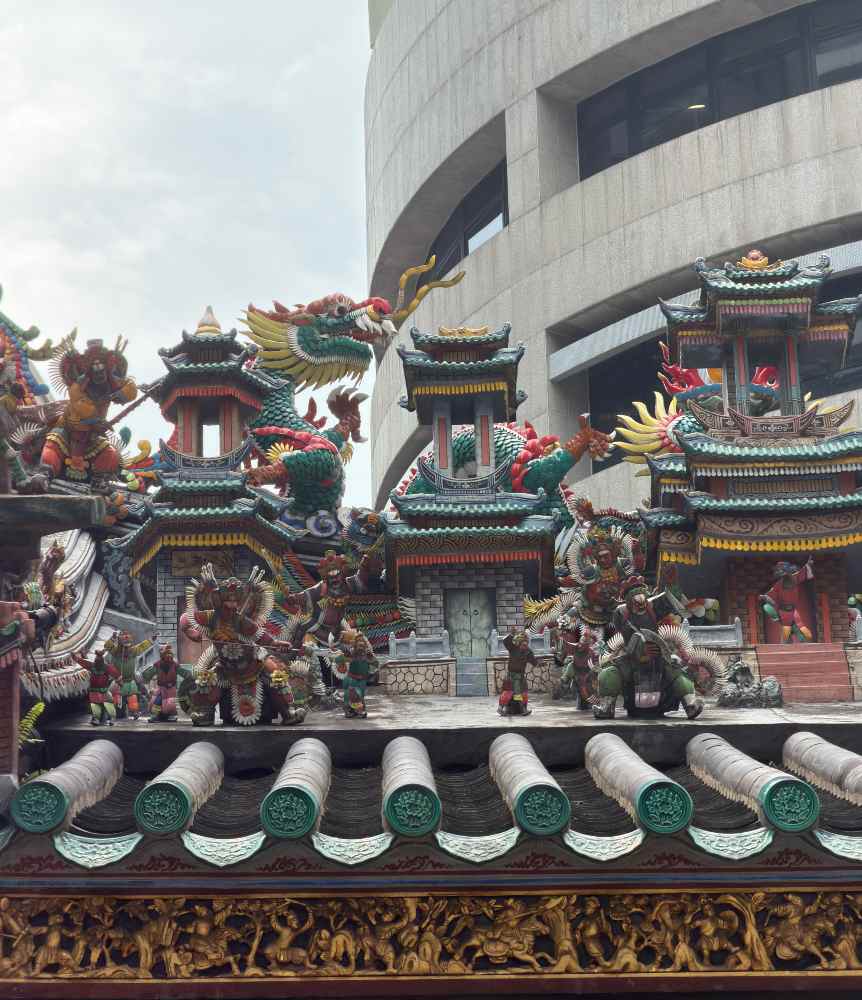
IMAGES: NG KAI
The detailed roofs
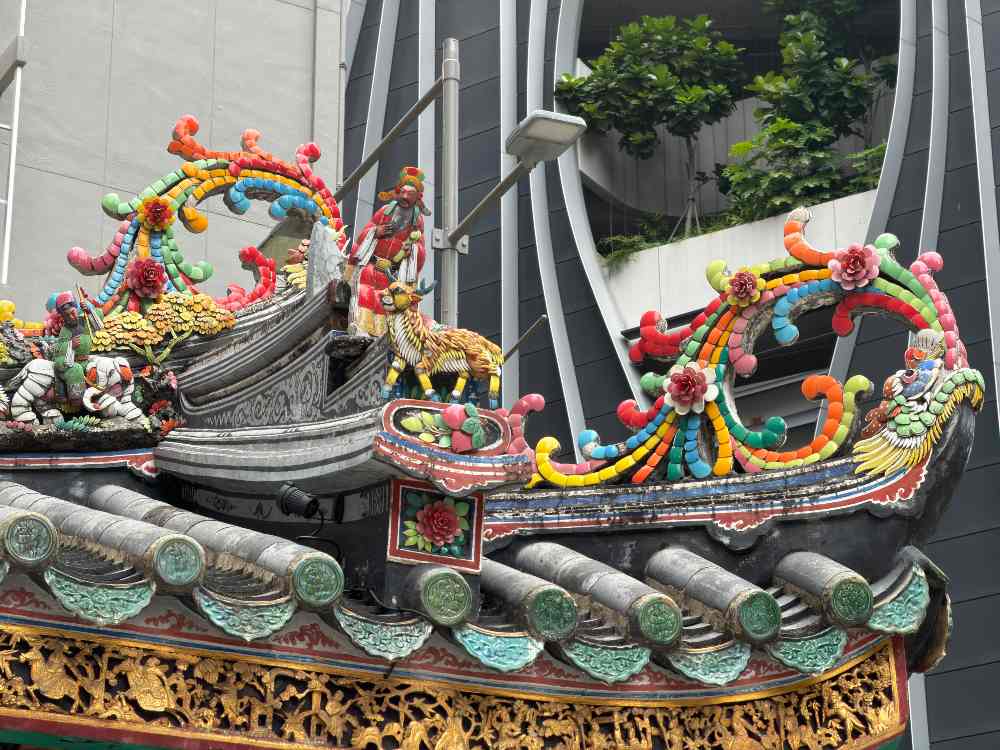
Make sure you look up. The temple’s stunning roof decorations, including detailed depictions of dragons, were created using a traditional technique from Guangdong known as qian ci (嵌瓷), more commonly referred to as jian nian (剪粘), which translates to "cut and paste". This method involves carefully cutting colourful ceramic pieces into smaller shapes and arranging them into intricate mosaic designs.
Similar decorative work can also be seen on the roofs of other National Monuments in Singapore, such as the Former House of Tan Yeok Nee, Thian Hock Keng, Former Keng Teck Whay Building, Hong San See, and Lian Shan Shuang Lin Monastery.
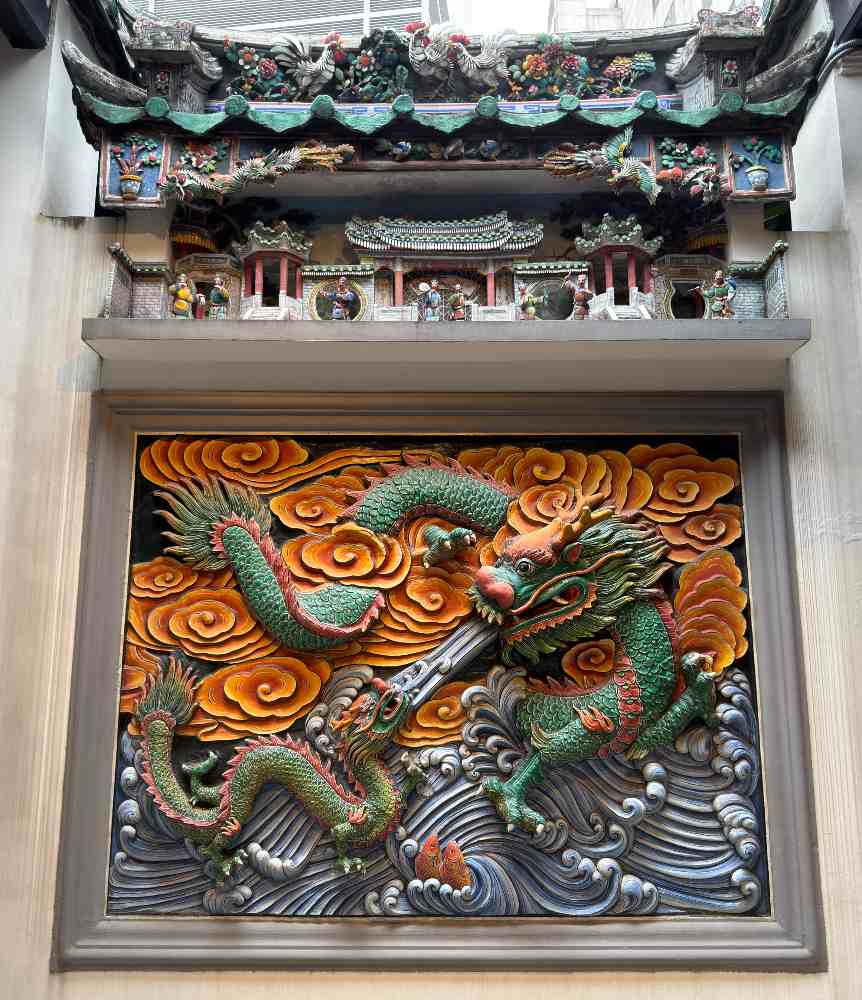
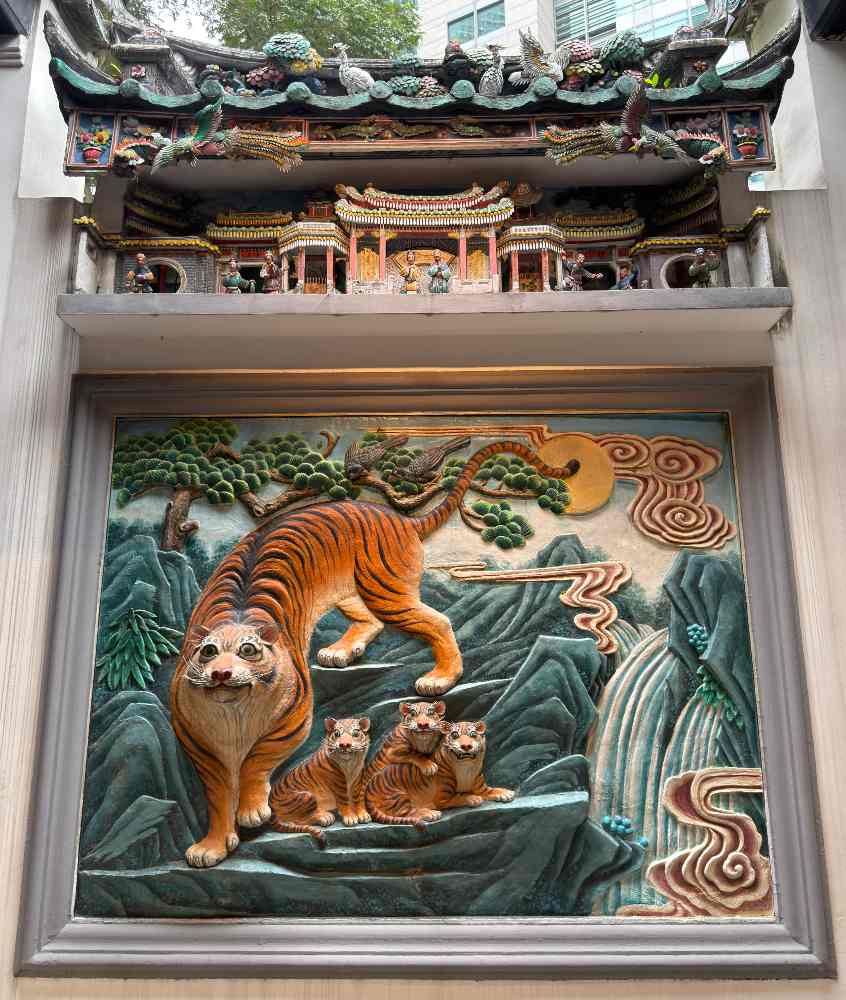 IMAGES: NG KAI
Beautiful carvings inside the temple
Its interior is adorned with elaborate carvings that portray scenes from well-known Chinese legends and folklore, including "Eight Immortals Crossing the Seas" (八仙过海), "Ruse of the Empty City" (空城计), and "Madam White Snake Steals Lingzhi Grass to Save Xu Xian" (白素贞偷灵芝草救许仙).
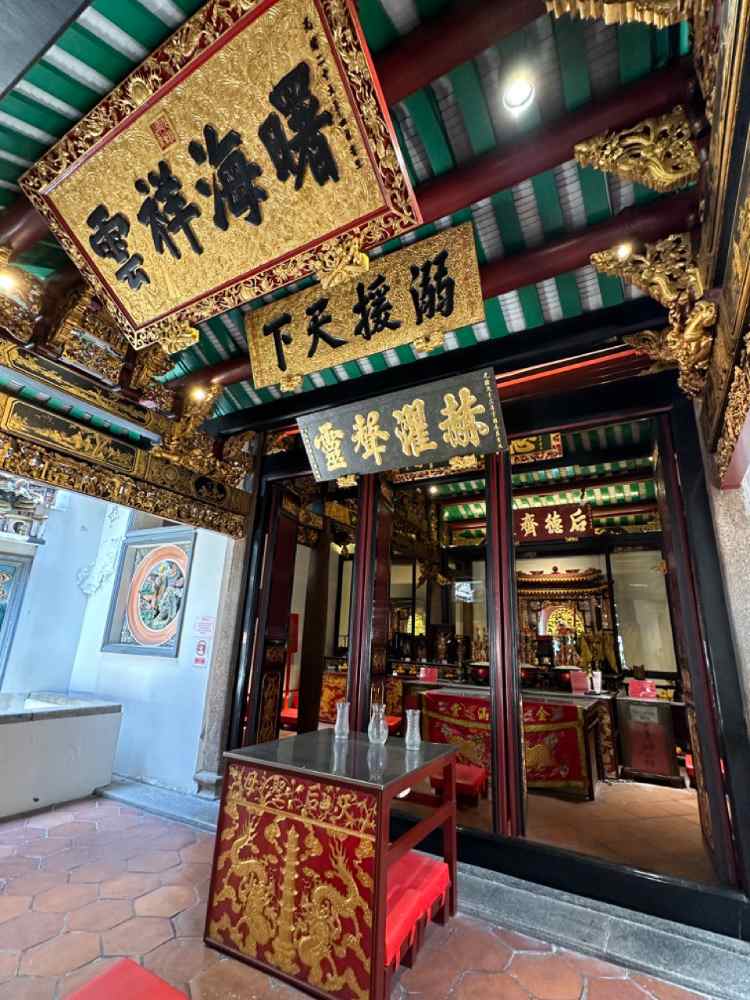
The words on the topmost plaque were blessings from an emperor of China! | IMAGE: NG KAI
An imperial plaque
The temple also has a major historical flex: in 1899, Emperor Guangxu of the Qing Dynasty presented Yueh Hai Ching temple with a scroll bearing four calligraphic characters – shu hai xiang yun (曙海祥云) – personally inscribed by him.
Translated as “moving seas with peaceful clouds above”, the phrase symbolised the Emperor's blessings to the Chinese community in Singapore. This honour was granted in appreciation of the temple’s donation towards flood relief efforts in Shandong, China.
The characters were later carved onto a large wooden plaque, which still hangs prominently in the temple. Apart from Yueh Hai Ching temple, Thian Hock Keng is the only other temple in Singapore known to have received a similar imperial honour.
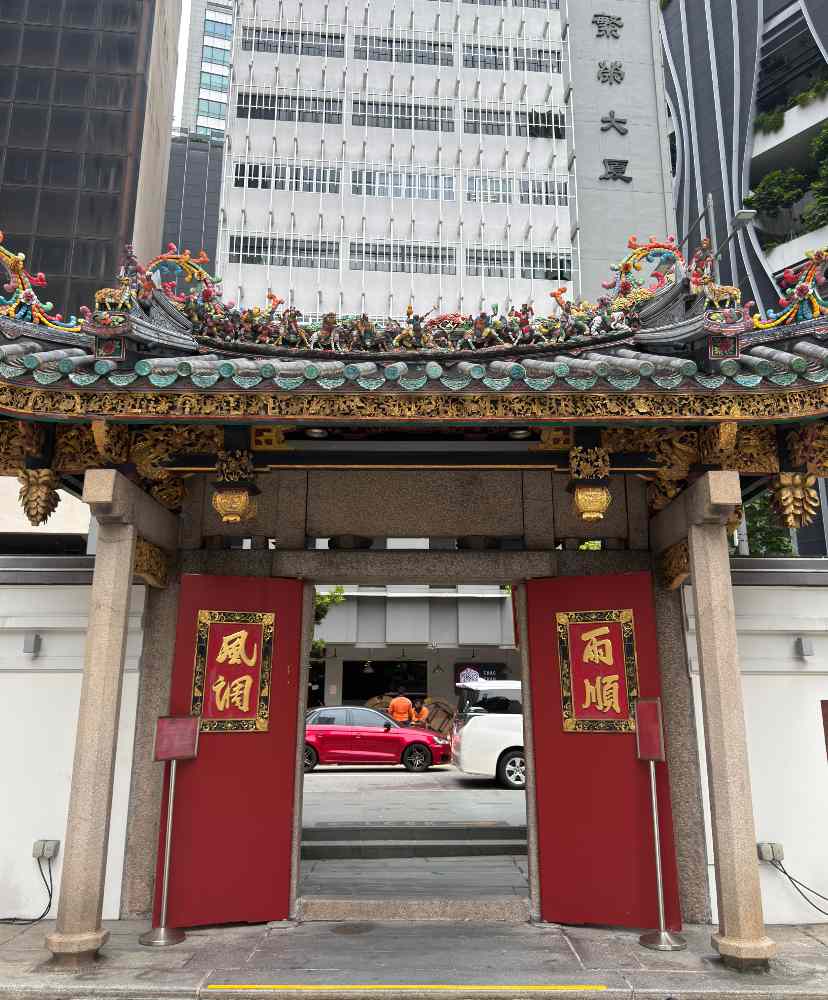 IMAGE: NG KAI
Yueh Hai Ching temple today
More than two centuries after Teochew immigrants first established a shrine here, Yueh Hai Ching Temple remains an active place of worship in one of Singapore’s busiest business districts.
That was my favourite thing about visiting. Distracted during lunch hour, I found myself standing inside this National Monument connecting early immigrants, sea voyages, imperial China, centuries-old craftsmanship and devotees hoping to meet someone special.
PS: if Yue Lao does come through for you, I expect a wedding invite.
Wait, what makes something a National Monument?
In Singapore, National Monuments are buildings, structures or sites recognised for their national significance and value to our built heritage. They are gazetted by the Preservation of Sites and Monuments, a division of the National Heritage Board, which is why the title is reserved for places that carry especially important historical, architectural, social or cultural meaning.
As of 2026, Singapore has 77 National Monuments. Some are obvious landmarks, like the Padang, St Andrew’s Cathedral and Fort Siloso. Others are places you may have walked past without a second thought, which is exactly why this series exists.
One National Monument at a time, we’re here to uncover the stories hiding in plain sight.
For the latest updates on Wonderwall.sg, be sure to follow us on TikTok, Telegram, Instagram, and Facebook. If you have a story idea for us, email us at [email protected].